Advertisement
Space.Fan — Go Beyond
AJ · 7 HR AGO
UniversePEER REVIEWED

A New AI Tool Helps Scientists Map Distant Quasars

By Space.Fan Editorial Desk

Researchers have found that a new type of artificial intelligence can better estimate the distances to bright, glowing objects called quasars.

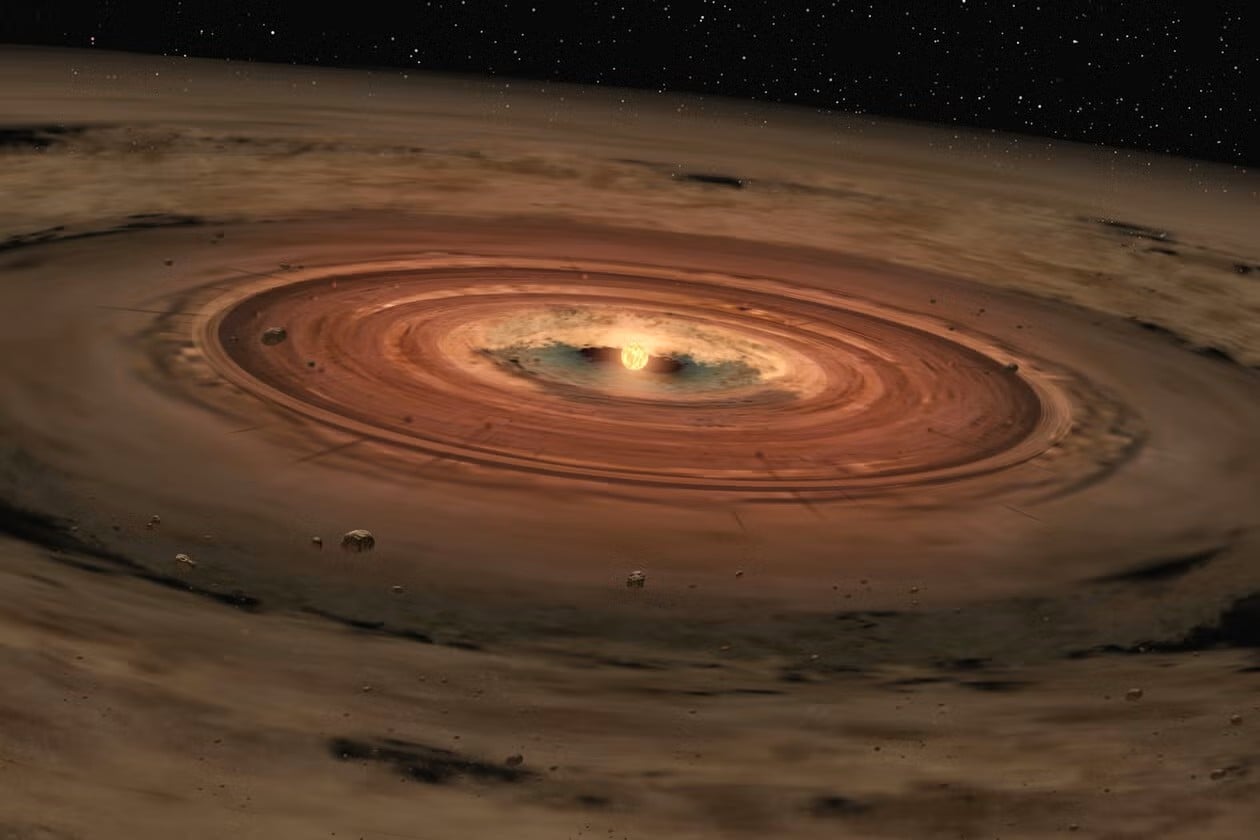
A black hole or eclipse corona glowing in deep space.

The Drop

Scientists often use space surveys to study quasars, which are extremely bright centers of distant galaxies powered by giant s. To understand the universe, astronomers need to know exactly how far away these objects are. This process is called finding the redshift. However, it is very hard to calculate this distance using only basic images from telescopes because quasars can look similar even when they are at very different distances. To solve this, researchers tested a powerful type of computer program known as a tabular foundation model. This AI, called TabPFN 2.5, acts like a digital detective. By feeding the AI data from a survey called S-PLUS—which looks at the sky through twelve different color filters—the team was able to train the model to recognize the subtle patterns that reveal a quasar’s true distance. The team compared this new AI against eight other traditional methods used in astronomy. They found that the new AI was consistently more accurate, especially when they had only a small amount of data to work with. It was particularly good at handling 'difficult' quasars, such as those that are very faint or located extremely far away in the deep reaches of space. By using the AI to look at data from the Wide-field Infrared Survey Explorer, the researchers found that infrared light is a very strong clue for finding distances. While traditional tools often struggle when the data is messy or incomplete, this AI model stayed reliable and consistent.
Advertisement

Why It Matters

Mapping the universe requires measuring millions of distant objects. Previously, this took a massive amount of time because scientists had to manually review or use complex statistical models that were prone to errors. This new AI makes the process much faster and more accurate. This matters because a more precise map of where quasars are located helps astronomers understand how the universe has grown and changed over billions of years. By automating this task with high precision, researchers can study larger parts of the sky than ever before.
Advertisement

The Catch

While the AI is very smart, it is not perfect. The researchers noted that running this model requires a lot of computing power, specifically from high-end graphics cards. If scientists want to map the entire sky with it, they might need to simplify the data first or find ways to make the program run on less powerful computers.

Put That in Perspective

In the past, astronomers had to rely on simple color charts to guess the distance of objects in space. Today, we are moving toward an era where AI helps us look at huge amounts of data that would be impossible for a human to process alone. Future studies will likely test if this AI can be used for other types of stars and galaxies, not just quasars.

Source September 28, 2026
AJ

Keep Exploring Space