Advertisement
Space.Fan — Go Beyond
arXiv · 9 HR AGO
UniverseSIMULATION

A New Way to Map How Galaxies Build Stars Over Time

By Space.Fan Editorial Desk

Researchers found a clever way to track galaxy growth by filtering out the messy movement of stars over billions of years.
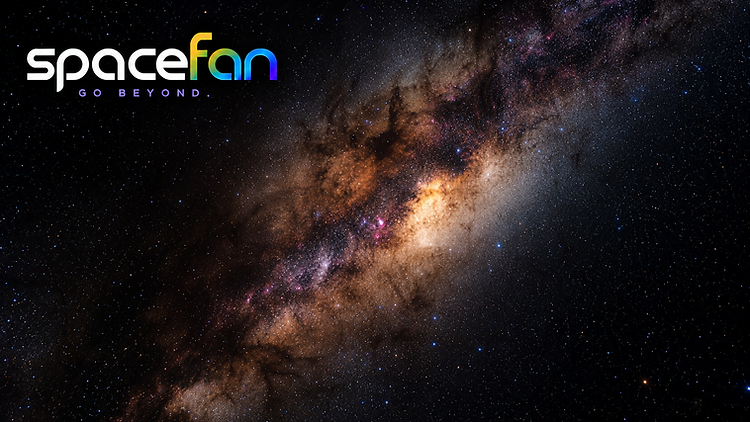
Dense star fields and glowing dust clouds across the center of the Milky Way galaxy.
Image · Space.Fan

The Drop

Galaxies are busy places where s are constantly being born. Scientists want to look back in time to see exactly where and when these s formed, but this is difficult because s do not stay still. Over time, they move around within their galaxy, which creates a blurring effect that hides the true history of how a galaxy grew. This movement makes it hard to tell exactly where the -forming action was happening in the past. To solve this, researchers used a high-tech computer simulation called h277 to act like a time machine. This simulation acts out the life of a galaxy similar to our own Milky Way, tracking how s form and migrate over time. By testing how to group data into different radial bins—essentially looking at the galaxy in rings from the center to the edge—they found a surprising trick. The way scientists already group this light data to make it clearer actually cancels out most of the confusion caused by movement. By using this method, they can accurately see the patterns of birth from up to 1.5 billion years ago. It allows them to recover the speed of formation and even spot where old pockets of -making gas were located.
Advertisement

Why It Matters

This finding is a big deal for upcoming space surveys that will map millions of galaxies. It proves that we can get very accurate maps of galaxy growth even without seeing the movement of every individual . By knowing that this grouping method works, scientists can trust their data more when they try to figure out how galaxies age and stop making new s.
Advertisement

The Catch

This method is not perfect for every galaxy. The researchers found that if a galaxy recently had a major collision with another galaxy, the data becomes very messy and unreliable. In these specific cases, this way of mapping history does not work, and scientists should avoid trying to trace formation in those disturbed galaxies.

Put That in Perspective

Astronomers have long struggled with the problem of stellar migration. Earlier studies often had to ignore this movement or treat it as a source of error. By confirming that standard data-grouping techniques handle this movement well, future studies using data from big projects like the Vera C. Rubin Observatory will be much more reliable.

Source November 26, 2026
Charlotte Olsen, Charlotte Welker, Ena Chia, Anna C Wright
ApJ·10.48550/arXiv.2611.33326

Keep Exploring Space