Advertisement
Space.Fan — Go Beyond
ApJ · 2 HR AGO
UniversePEER REVIEWED

A New Way to See How Stars Are Born

By Space.Fan Editorial Desk

Scientists have found a better way to track the thick, cold gas clouds that collapse to form new stars.
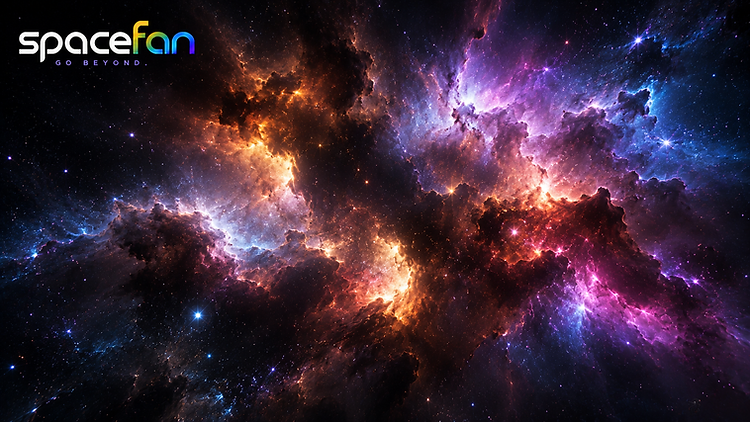
Colorful glowing nebula filled with stars and clouds of blue, purple, orange, and red gas.

The Drop

Space is filled with giant, cold clouds of gas. Inside these clouds, pockets of gas clump together and get heavy enough to pull in even more material. Eventually, these clumps become so dense that they trigger the birth of a new . For a long time, scientists have used pictures of space dust to guess where these heavy gas clumps are located. However, dust can be hard to see clearly, especially when it is hidden behind other things in space. Now, researchers have created a new method to map these clouds using special types of carbon monoxide gas. By looking at different versions of carbon monoxide molecules, the team can trace the motion of the gas inside the clouds. They tested this method on 16 different gas clouds in our galaxy and found that their results matched the old dust-based pictures perfectly. This gives scientists a new way to study -forming gas that is both accurate and very detailed.
Advertisement

Why It Matters

This discovery matters because it gives astronomers a new tool to study how s form. While looking at dust is a great way to see clouds, using gas signals allows researchers to measure how the gas is moving. This adds a new layer of information to our maps, helping us understand not just where gas is, but how it is flowing toward becoming a . It confirms that we can use these gas signals to get the same results as older methods, while adding extra speed and detail.
Advertisement

The Catch

This study is limited because it focused on 16 specific gas clouds in the Milky Way. While these clouds represent different environments, it is not yet clear if this method will work just as well in other galaxies where conditions are very different from our own. Researchers will need to apply this technique to a wider variety of regions to be sure it is a perfect match for all types of -forming clouds.

Put That in Perspective

Scientists have used dust to map star-forming clouds for many years. Adding this new gas-tracking method allows researchers to study these regions with more detail than before. Future studies will likely test if this gas-based approach can reveal even smaller details in distant galaxies that we cannot currently see clearly.

Source October 2, 2026
ApJ

Keep Exploring Space