Advertisement
Space.Fan — Go Beyond
Universe Today · 18 HR AGO
DiscoveriesPEER REVIEWED

A Powerful Black Hole Jet Caught in High Detail

By Space.Fan Editorial Desk

Scientists used a global network of telescopes to zoom in on a massive, glowing jet of energy shooting out from a distant black hole.
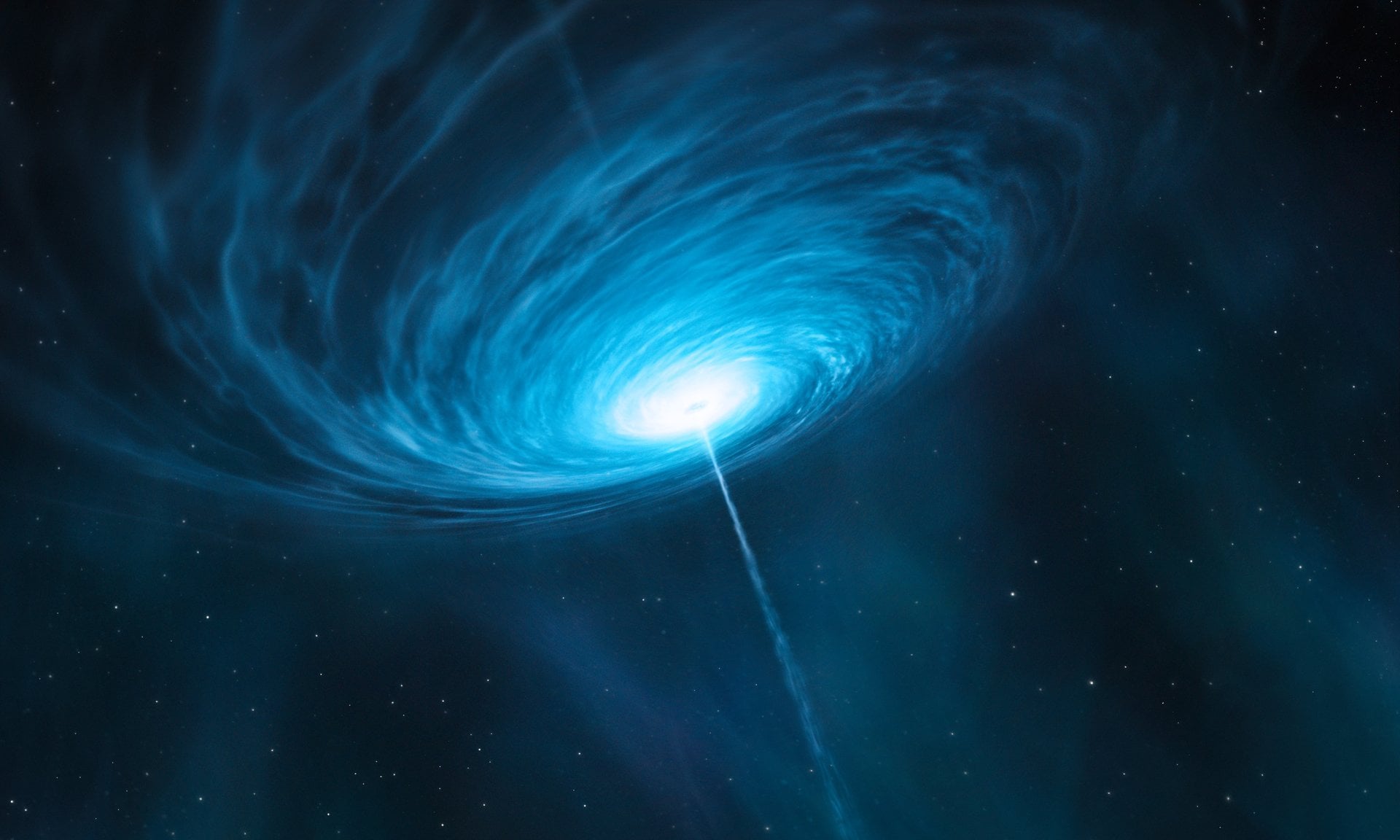
An artist interpretation showing a bright orange and yellow glowing jet erupting from the center of a swirling galaxy.
Image · Universe Today

The Drop

The Event Horizon Telescope (EHT) is a team of observatories spread across the Earth that work together like one giant camera. By acting as one, they can see objects in space with incredible detail. Recently, this team looked at a blazar named 3C 279, which is a very bright galaxy with a giant at its center. This has a mass 800 million times larger than our Sun. From its middle, it blasts out a jet of space gas that moves at speeds close to light. Because the jet is pointed directly at us, it is a perfect target for study. Using data from 2021, the team successfully mapped the shape and movement of the jet closer to the than ever before. This was made possible by adding two new telescopes to the group, located in Arizona and the French Alps. These new locations helped the team zoom into the tiny, crowded region where the jet first forms. The team found that the jet actually bends as it travels away from the center of the galaxy.
Advertisement

Why It Matters

Understanding how these jets move helps scientists learn what powers the most active objects in the universe. By mapping the base of the jet, researchers can test theories about how gravity and magnetism work around a giant . This helps prove how matter falling into a gets pushed back out as a powerful beam of energy.
Advertisement

The Catch

While the new images give us a much better look at the jet, there is still a lot we do not see. The team is looking at data that shows us the general shape of the jet, but many details about the exact physical processes happening inside the flow are still being modeled. Scientists have to combine this new information with older data to guess what is happening at the very center, so there is still room for different interpretations of the data.

Put That in Perspective

The EHT has already shown us pictures of the black holes in the center of the M87 galaxy and our own Milky Way. This new study is part of an ongoing effort to make the telescope array sharper every year. Researchers plan to keep adding more telescopes to the global network to get even clearer views of how black holes affect their surroundings.

Source November 25, 2026
Hendrik Müller
National Radio Astronomy Observatory, Max-Planck-Institut für Radioastronomie·Astronomy & Astrophysics

Keep Exploring Space