Advertisement
Space.Fan — Go Beyond
ApJ · 3 HR AGO
Sun & Space WeatherPEER REVIEWED

A Solar Flare Without a CME Still Packs a Punch

By Space.Fan Editorial Desk

Scientists discovered that small solar eruptions can create powerful shock waves even when they do not release a massive cloud of particles.
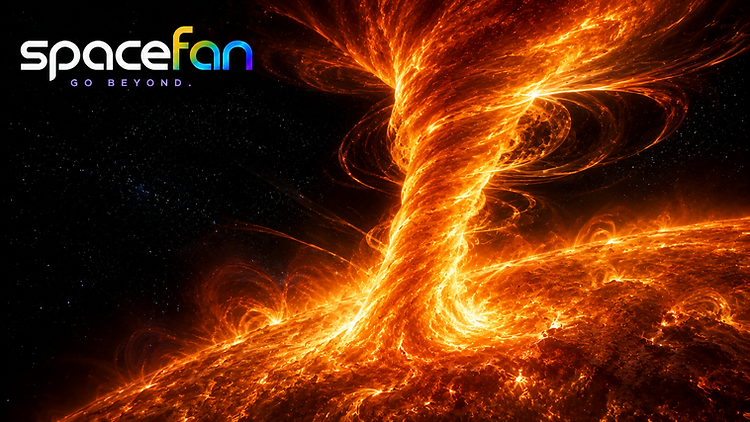
Huge twisting prominence of glowing plasma erupting above the surface of the Sun.
Image · Space.Fan

The Drop

On November 6, 2024, the Sun unleashed a powerful blast of energy known as an X2.3-class solar flare. Usually, these large flares are followed by a Coronal Mass Ejection, or CME. A CME is like a massive bubble of solar material and magnetic fields being thrown into space. However, in this specific event, space telescopes and cameras did not see any large CME at all. Even though the big cloud was missing, the Sun still produced something very interesting: a high-frequency type II radio burst. Scientists used several space instruments to track the event, including the Solar Dynamics Observatory and the STIX telescope on the Solar Orbiter. They noticed a moving disturbance in the Sun's atmosphere shortly after the flare began. They also tracked radio signals that showed how fast energy was moving away from the blast site. By comparing these observations, the team realized that a small, compact structure called a magnetic flux rope had erupted. This flux rope acted like a spring that suddenly snapped. Even though it did not cause a massive CME, the snap was strong enough to create a shock wave in the low layers of the Sun's atmosphere. This shock wave traveled outward, creating the radio signals that scientists detected from Earth.
Advertisement

Why It Matters

This discovery is important because it changes how we think about solar storms. Before, experts believed that only the giant CME clouds could create these specific types of radio bursts. Finding that a smaller, compact eruption can cause the same result helps researchers better understand the variety of ways the Sun releases energy. By studying these compact eruptions, scientists can get better at predicting space weather. Knowing that even smaller events can trigger shock waves helps us better prepare for how solar activity might impact satellites, GPS, and communication technology near Earth.

Aurora Tonight

Live NOAA outlook

Slight aurora activity

Mostly Arctic: Alaska, northern Canada, Greenland, and far-northern Europe

Aurora activity38%
Peak Kp tonight: 3.7NOAA nowcast max: 32%Source: NOAA SWPC

Aurora forecasts are probabilistic. Darkness, clouds, local light pollution, and rapidly changing solar-wind conditions affect what you can actually see.

Advertisement

The Catch

While the data is strong, this study focuses on one specific event. Researchers were able to connect the radio bursts to the movement of a magnetic flux rope, but they cannot say for certain if every similar radio burst follows this exact same pattern. It is possible that other kinds of solar activity could create similar radio signatures, which means more research is needed to see if this process happens during every flare of this type.

Put That in Perspective

Scientists have studied solar flares for many years, but the combination of modern tools like the Aditya-L1 satellite and the Solar Orbiter allows for a much more detailed view of what happens on the Sun's surface. Researchers will likely use this new knowledge to look back at older data to see if they missed these hidden eruptions in past solar events.

Source September 25, 2026
ApJ

Keep Exploring Space