
Advertisement
Space.Fan — Go Beyond
ApJ · 4 HR AGO
Life?SIMULATION

A Star's Age Changes How We Hunt for Life on Other Planets

By Space.Fan Editorial Desk

A star's UV light can hide or reveal signs of life, meaning we must consider a star's age when studying far-off worlds.
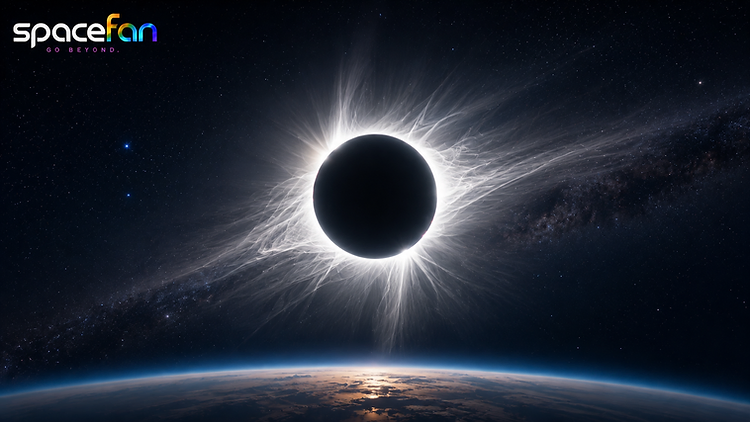
Total solar eclipse with a brilliant white corona suspended above the curved horizon of Earth viewed from space.
Image · Space.Fan

The Drop

Scientists are using computer models to understand how s affect the atmospheres of s that orbit them. They focused on M s, which are the most common type of in our galaxy. These s are great targets for looking for signs of life because they are smaller and cooler than our Sun. However, these s change a lot as they grow older. A young M gives off much more intense ultraviolet (UV) light than an older one. This UV light is important because it acts like a chemical factory in a 's atmosphere. It can break apart gases or build new ones, which directly changes the air we observe from Earth. To test this, researchers simulated two different types of Earth-like s orbiting M s of different ages. They looked at how the atmospheres reacted when exposed to the high energy of a young versus the gentler light of an older, mature . They found that the age of the changes the chemical balance of a 's air significantly. For example, some s showed much higher levels of methane when orbiting an older . This means that a 's chemical signature depends just as much on its 's age as it does on the life that might exist there.
Advertisement

Why It Matters

This discovery is a major step forward because it helps us avoid misinterpreting what we see in deep space. If we do not account for a 's age, we might mistake the natural chemicals caused by light for signs of biological life. For instance, high levels of ozone might look like a sign of life, but the research shows this can happen naturally just because of the 's harsh UV rays. Understanding these stellar influences ensures that when we eventually find a potential biosignature, we can be much more confident that it truly comes from living organisms and not just the local weather around the .
Advertisement

The Catch

These findings come from computer simulations rather than direct observations of distant s. While the models are highly detailed, they make assumptions about how atmospheres behave based on our own Earth. Real s may have different clouds, volcanic activity, or oceans that could change how their air reacts to UV light. Furthermore, detecting these fine details in distant atmospheres is extremely difficult with our current technology, so we still need more powerful telescopes to put these theories to the test.

Put That in Perspective

Astronomers hope that upcoming tools like the Habitable Worlds Observatory will have the sensitivity to see these subtle chemical fingerprints. By building these sophisticated models today, researchers are creating a map to help future missions know exactly what to look for when they peer into the deep sky.

Source October 2, 2026
ApJ

Keep Exploring Space