Advertisement
Space.Fan — Go Beyond
arXiv · 9 HR AGO
UniverseEARLY RESEARCH

Clearing the Cosmic Fog: Why Intergalactic Dust Won't Change Our View of Dark Energy

By Space.Fan Editorial Desk

Scientists are finding ways to see through the hidden dust floating between galaxies to get a clearer picture of how our universe expands.
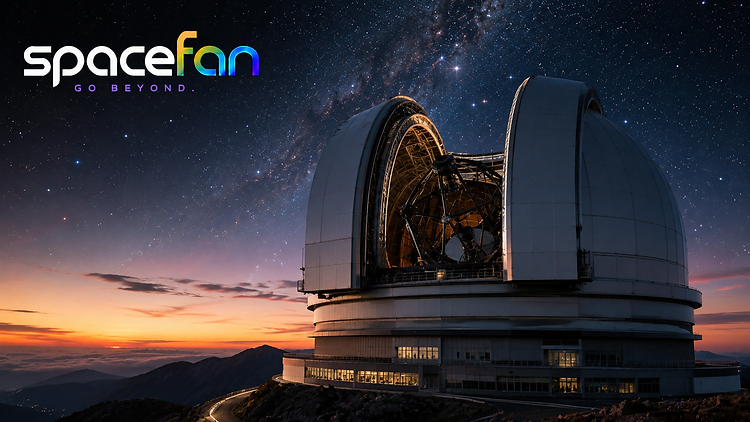
Large astronomical telescope inside an open mountain observatory dome beneath a star-filled night sky.
Image · Space.Fan

The Drop

Space is not completely empty. Tiny grains of dust float in the massive spaces between galaxies. Scientists call this intergalactic dust. Because this dust can dim the light from distant exploding s, known as s, it makes it hard for us to measure exactly how fast the universe is growing. If we cannot measure the light accurately, we might get the wrong ideas about dark energy, the mysterious force that pushes the universe apart. Researchers looked at data from the Dark Energy Survey to see if this dust was causing problems. While the current data was not enough to tell us exactly how much dust is out there, the team used computer simulations to predict how future space telescopes will perform. By looking at the specific ways light colors change over distance, they found a clever method to identify and filter out the interference from this dust. They found that the upcoming Roman Space Telescope will be a game changer. It will be much better at measuring this dust than the current tools or even the future Rubin Observatory. By using the Roman telescope to map the dust, scientists can then clean up the data from other surveys to get a much more accurate result.
Advertisement

Why It Matters

Understanding this dust is important because it acts like a filter on a camera lens, changing the colors and brightness of light from the deep universe. If we do not account for this dust, we might incorrectly think dark energy is changing when it is actually just the dust blocking our view. This research confirms that we can successfully separate the effects of dust from the actual expansion of the universe, ensuring our measurements of dark energy remain accurate.
Advertisement

The Catch

This study relies on models and simulations of how dust behaves, which are our best guesses but not yet observations of real dust clouds in deep space. There is still a chance that dust behaves in ways we have not predicted yet, which would mean our correction methods might need adjustment once we t getting real data from these new telescopes.

Put That in Perspective

Scientists have been studying dust in our own galaxy for a long time, but studying it between galaxies is a newer challenge. By using the Roman Space Telescope as a 'dust-checker,' researchers hope to boost the accuracy of our maps of the universe, moving from vague guesses to precise measurements.

Source November 26, 2026
Erik R. Peterson, Dillon Brout, Daniel Scolnic, Bastien Carreres, Rebecca C. Chen, Richard Kessler, Brodie Popovic, Benjamin M. Rose, Maria Vincenzi, Maria Acevedo, John Franklin Crenshaw, Lluís Galbany, Matthew Grayling, Benne W. Holwerda, Jacqueline McCleary, Ayan Mitra, Rujuta Purohit, Corentin Ravoux, Masao Sako, Bruno O. Sánchez, Christopher W. Stubbs, Syed Uddin
The LSST Dark Energy Science Collaboration, The Roman Science Collaboration·ApJ·10.48550/arXiv.2611.33276

Keep Exploring Space