Advertisement
Space.Fan — Go Beyond
AJ · 6 DAYS AGO
UniverseNEW OBSERVATION

Is a Hidden Companion Star Messing With Betelgeuse?

By Space.Fan Editorial Desk

New radio telescope data shows that the giant star Betelgeuse is being pushed and pulled by an unseen object orbiting nearby.
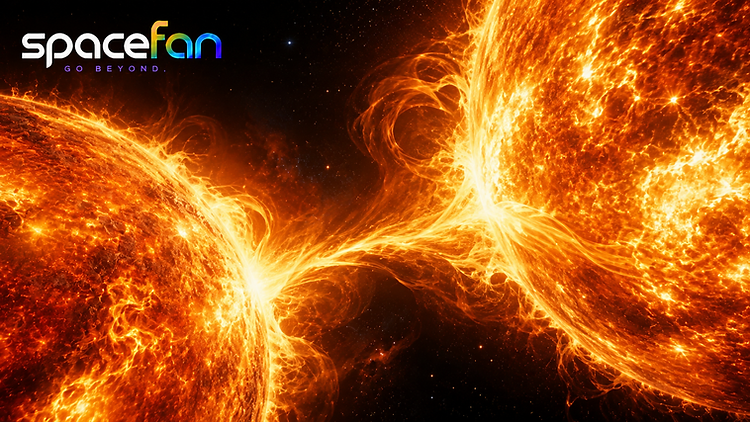
Two fiery stars interacting through huge glowing loops and streams of stellar plasma.
Image · Space.Fan

The Drop

Astronomers have been watching the giant Betelgeuse closely ever since its mysterious Great Dimming event in 2019. By using two powerful telescope systems, the Very Large Array and the Atacama Large Millimeter/submillimeter Array, scientists were able to map out the 's hot outer atmosphere in great detail. They looked at the using radio waves, which let them see through the thick dust that often blocks our view of what is happening on its surface. By watching the over several years, the team could track how the gas in its atmosphere changed shape and temperature. These radio measurements showed that the does not look like a perfect circle. Instead, its shape changes in a repeating pattern. The team discovered that these changes line up perfectly with where a small, hidden companion would be if it were orbiting Betelgeuse. This suggests the smaller object is physically tugging on the giant as it circles around it, causing the outer gas layers to wobble.
Advertisement

Why It Matters

This discovery is important because it changes how we think about the life of massive s. If Betelgeuse has a companion, it explains why the ’s atmosphere behaves so strangely. It helps scientists understand how giant s lose mass and change shape before they eventually explode as s. Confirming the presence of a neighbor helps build a much more complete map of how this famous system works.
Advertisement

The Catch

While the data fits the idea of a companion , it is not a direct photograph. The scientists are seeing the effects of the companion on the gas, but they have not directly spotted the object itself. It is possible that the wobbles are caused by something else, such as extreme, natural convection bubbles rising from deep inside the giant that just happen to look like a pattern.

Put That in Perspective

Betelgeuse is one of the closest supergiant stars to Earth, and it has been studied for decades. Before 2016, the star's atmosphere seemed much more stable. The fact that its current shape has changed significantly shows just how dynamic and unpredictable the life of a massive star can be as it nears its final stages.

Source September 5, 2026
L. D. Matthews, A. K. Dupree, A. M. S. Richards, W. R. F. Dent
Massachusetts Institute of Technology Haystack Observatory, Center for Astrophysics Harvard & Smithsonian, Jodrell Bank Centre for Astrophysics, European Southern Observatory·The Astronomical Journal·10.3847/1538-3881/ae953d

Keep Exploring Space