Advertisement
Space.Fan — Go Beyond
ApJL · 2 DAYS AGO
DiscoveriesPEER REVIEWED

James Webb Telescope Finds Rare Sulfur Gas on Distant Planets

By Space.Fan Editorial Desk

Scientists have spotted a new chemical clue in the skies of distant gas giants, helping us understand what their atmospheres are made of.
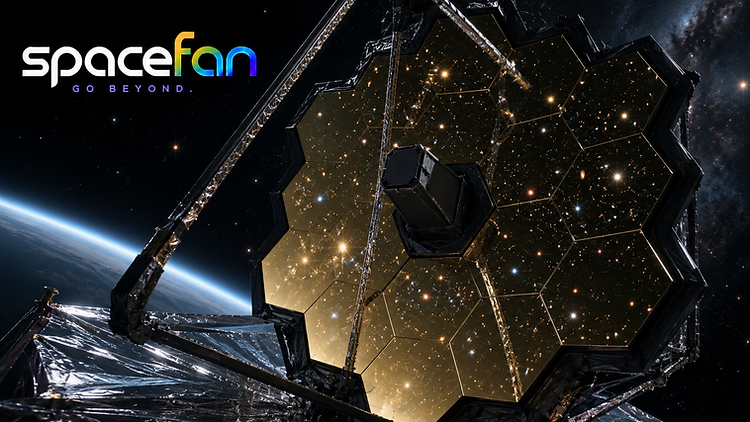
James Webb Space Telescope in space with its gold segmented mirror facing the stars.

The Drop

Astronomers have discovered a special type of gas called carbon disulfide in the atmospheres of s far beyond our own solar system. They used the powerful James Webb Space Telescope to peer at these distant worlds. By studying the light coming from these s, the team found a unique chemical signature that acts like a fingerprint for the gas. This discovery was made while observing a gas giant named TOI-6894 b. The researchers think this gas is created through a mix of chemical reactions that happen when light from a nearby hits the 's atmosphere. This process brings together carbon and sulfur, which are key ingredients in the 's air. By building computer models, the team figured out how these ingredients combine to form the gas we see today. They found that this chemical process is most active on s with a specific temperature range, which helps explain why some s show signs of this gas while others do not.
Advertisement

Why It Matters

Finding this gas is a big deal because it acts like a new tool for scientists. Before this, it was hard to study sulfur chemistry on s that were not extremely hot. Now, researchers have a way to peek at the ingredients in the air of cooler gas giants. This helps them understand what these s are made of and how their atmospheres change over time.
Advertisement

The Catch

This study relies on computer models to explain the chemistry. While these models fit the data well, they are still estimates based on current knowledge. The researchers only observed a few s, so they still need to study more worlds to see if these patterns hold true for all gas giants across the galaxy.

Put That in Perspective

Scientists have only recently started spotting sulfur chemicals on other planets thanks to the James Webb Space Telescope. This new work creates a guide that will help researchers know exactly what to look for when they study other giant planets in the future.

Source September 22, 2026
Jeehyun Yang, Vighnesh Nagpal, Michael Zhang, Qiao Xue, Eliza M.-R. Kempton, Jacob L. Bean, Michael R. Line, Jonathan J. Fortney, Peter Gao, Matthew C. Nixon, Caroline Piaulet-Ghorayeb, Kevin B. Stevenson, Madison Brady, Joost P. Wardenier, Luis Welbanks
University of Chicago, Arizona State University, University of California Santa Cruz, Carnegie Institution for Science, Johns Hopkins University Applied Physics Laboratory, Michigan State University, University of Bern·The Astrophysical Journal Letters·10.3847/2041-8213/aea4af

Keep Exploring Space