Advertisement
Space.Fan — Go Beyond
arXiv · 19 HR AGO
UniversePEER REVIEWED

New Map Reveals How Space Clouds Build Water Ice

By Space.Fan Editorial Desk

Scientists have discovered that the location of space radiation changes how and where water ice forms in giant cosmic clouds.
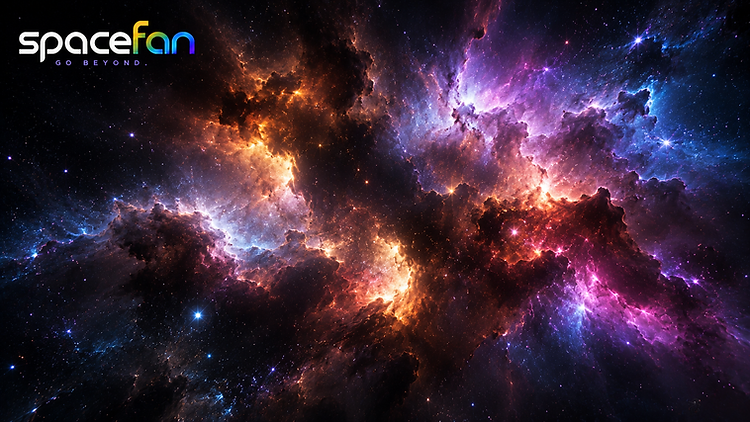
Colorful glowing nebula filled with stars and clouds of blue, purple, orange, and red gas.
Image · Space.Fan

The Drop

Space is filled with massive clouds of gas and dust where new s are born. Inside these clouds, water turns into ice that coats tiny grains of space dust. For a long time, experts thought this ice appeared at the same depth in every part of a cloud. A new study of the Ophiuchus cloud suggests the process is much more complex. Researchers looked at over 43,000 different spots in the Ophiuchus cloud. They used old data from two space telescopes, WISE and Spitzer, which captured infrared light. By looking at how these s shine through the dust, the team could measure exactly where the water ice begins to coat the grains. They found that the ice does not show up at a set depth everywhere. Instead, it depends on the local environment. Areas with more intense ultraviolet light from nearby s force the ice to form much deeper inside the cloud. It is similar to how a bright sun can evaporate moisture on the ground faster than a shaded area. The team measured this by tracking 12-micron light, which acts as a glow-in-the-dark marker for how strong the radiation is in a specific area. This tells us that the ingredients for s and s are not spread out evenly, but are instead shaped by the local neighborhood of the cloud.
Advertisement

Why It Matters

Understanding where ice forms is critical because water ice is a key building block for s and potentially life. If we know where the ice is, we can better predict where rocky s might form. This discovery changes how astronomers compare different clouds in our galaxy. Before, they used a one-size-fits-all rule to guess how much ice existed in a cloud. Now, scientists know they must account for the local light and radiation environment to get an accurate picture.
Advertisement

The Catch

While this study shows a clear link between radiation and ice, the researchers noted that their current data is a broad map. They need more precise, detailed light readings to confirm exactly how strong the radiation is in every spot. They hope that future missions, like SPHEREx and the James Webb Space Telescope, will provide a more detailed look at the ice molecules themselves to confirm these findings.

Put That in Perspective

Scientists have long suspected that radiation breaks down ice in space, but this is the first time they have been able to map this effect across a massive cloud with such high detail. Future studies will likely test if this same pattern of 'shielding' appears in other regions of our galaxy.

Source November 23, 2026
Stefan Meingast, Zhetai Cao
Astronomy & Astrophysics·10.48550/arXiv.2611.26683

Keep Exploring Space