Advertisement
Space.Fan — Go Beyond
ApJ · 2 DAYS AGO
Sun & Space WeatherPEER REVIEWED

Parker Solar Probe Finds Clues to How the Sun Heats its Outer Atmosphere

By Space.Fan Editorial Desk

Scientists have found that strange magnetic bends in the solar wind act like tiny heaters for the particles flying off the Sun.
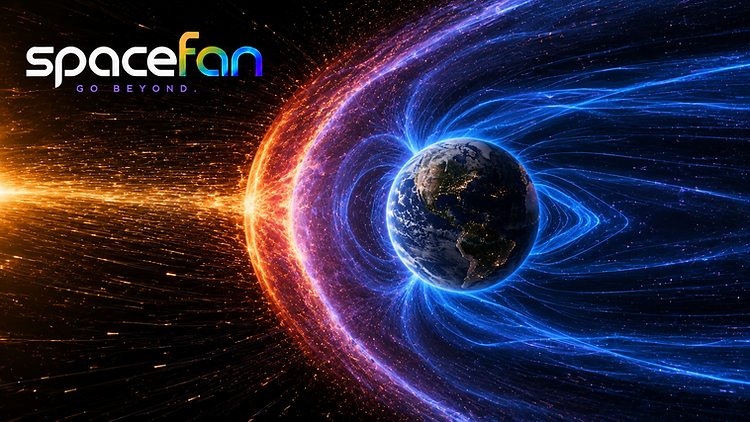
Earth surrounded by glowing magnetic field lines as solar particles strike the magnetosphere.
Image · Space.Fan

The Drop

The Sun constantly blows a stream of charged particles into space, known as the solar wind. Sometimes, this wind contains odd magnetic kinks called switchbacks, where the magnetic field suddenly bends back on itself. For a while, scientists were not sure if these bends were just an illusion caused by how we measure them, or if they were doing something active to the plasma around them. To solve this, researchers looked at data from the Parker Solar Probe, which flies closer to the Sun than any other spacecraft. By carefully checking the magnetic and electric field data, the team found that these switchbacks are actually real, physical structures. Inside these kinks, they discovered higher levels of wave activity and hotter temperatures. This confirms that switchbacks are not just strange shapes in the magnetic field, but are active sites where energy is transferred from the magnetic field to the particles. This process causes the plasma to heat up as it travels away from the Sun.
Advertisement

Why It Matters

One of the biggest mysteries in space science is why the solar wind gets hotter as it moves away from the Sun, rather than cooling down. These findings show that switchbacks act like local heating stations. They provide a specific mechanism for how energy moves from the Sun's magnetic field into the tiny particles, heating them up significantly.
Advertisement

The Catch

While this study shows a clear link between these magnetic bends and higher temperatures, it does not explain exactly how the energy transfer process ts. The researchers note that while the switchbacks clearly influence the heating, they are still studying the exact chain of events that triggers this energy release at such small scales.

Put That in Perspective

Scientists have been studying solar wind patterns for decades, but the Parker Solar Probe has provided a new perspective by getting right into the action near the Sun. Future missions will likely use these findings to model how much of the total solar wind heating is caused by these switchbacks versus other processes.

Source September 26, 2026
Kyung-Eun Choi, Oleksiy V. Agapitov, Forrest Mozer, Seung-Ju Yang, Dae-Young Lee, Richard D. Sydora, Lucas Colomban, Liudmyla Kozak, Mingzhe Liu, Marc Pulupa
Space Sciences Laboratory, University of California, Berkeley, National Taras Shevchenko University of Kyiv, Chungbuk National University, University of Alberta, Atomic Energy Commission·The Astrophysical Journal·10.3847/1538-4357/aea141

Keep Exploring Space