
Advertisement
Space.Fan — Go Beyond
ApJ · 15 HR AGO
UniversePEER REVIEWED

Solving the Mystery of Missing Light in White Dwarf Stars

By Space.Fan Editorial Desk

A new way to model light from dense stars is helping scientists finally match theory with what they see in the sky.
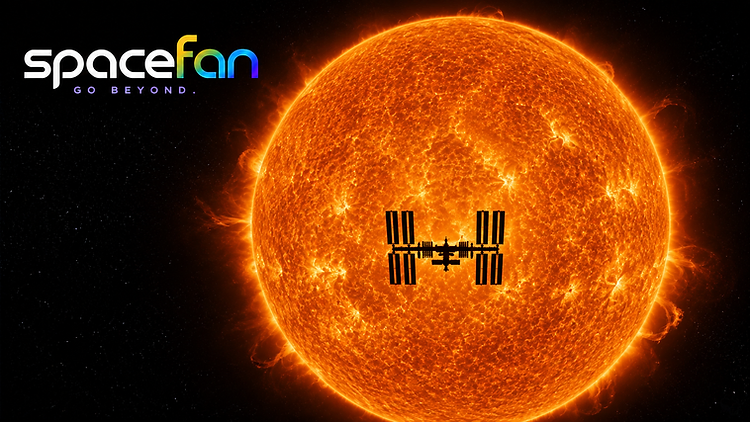
Silhouette of the International Space Station crossing in front of the bright orange Sun.
Image · Space.Fan

The Drop

Scientists have long struggled to explain why the light patterns from white dwarf s did not perfectly match their computer models. White dwarfs are the tiny, dense cores left behind when s like our Sun die. In these extreme environments, the atoms of hydrogen are squeezed so tightly together that they t to behave in strange ways. Specifically, when two hydrogen atoms bump into each other without actually sticking together, they form what researchers call a quasi-molecule. These short-lived pairs change how the emits light, creating gaps or bumps in the spectrum that previous models could not predict. To fix this, a team of researchers developed a new method that looks at both atomic and molecular states at the same time. By building this into a computer simulation, they were able to predict these special light signatures more accurately. When they compared these new calculations to actual observations of white dwarf s, the results matched much better than the older, simpler models. This confirms that these temporary pairings of hydrogen atoms are a key piece of the puzzle for understanding how light escapes from these dense stellar environments.
Advertisement

Why It Matters

This breakthrough is a big deal because it helps astronomers get more accurate data from white dwarf s. Because these s act like cosmic clocks, knowing their true temperature and composition is vital for measuring the age of our galaxy. By fixing the theory behind how light behaves in dense gas, researchers can stop guessing about the discrepancies and t using these s as more reliable tools for mapping the history of the universe.
Advertisement

The Catch

While these new models are a big improvement, they are still just simulations. The researchers focus on a specific type of hydrogen-atmosphere , so these results may not apply to every kind of white dwarf. Additionally, the complex interactions between these quasi-molecules are extremely difficult to calculate, meaning future updates may be needed as our computing power grows or as we find more examples of these s with better telescopes.

Put That in Perspective

Scientists have been trying to resolve these light discrepancies for years. By combining knowledge from atomic physics with stellar atmosphere models, this work shows that even small-scale physical processes can have a massive effect on how we see distant stars. Future studies will likely apply this method to other types of stars to see if the same effect explains mysteries in other parts of the galaxy.

Source September 30, 2026
Jackson R. White, Thomas A. Gomez, Mark C. Zammit, Michael H. Montgomery, Bart H. Dunlap, Ivan Hubeny, Dmitry V. Fursa, Igor Bray, Don E. Winget
University of Texas at Austin, Los Alamos National Laboratory, University of Colorado, University of Michigan, University of Arizona, Curtin University·The Astrophysical Journal·10.3847/1538-4357/ae8f2d

Keep Exploring Space