
Advertisement
Space.Fan — Go Beyond
ApJ · 3 HR AGO
UniverseMODEL

Solving the Mystery of Repeating Space Bursts

By Space.Fan Editorial Desk

Scientists have found a single explanation for the mysterious, flashing radio signals coming from deep space.
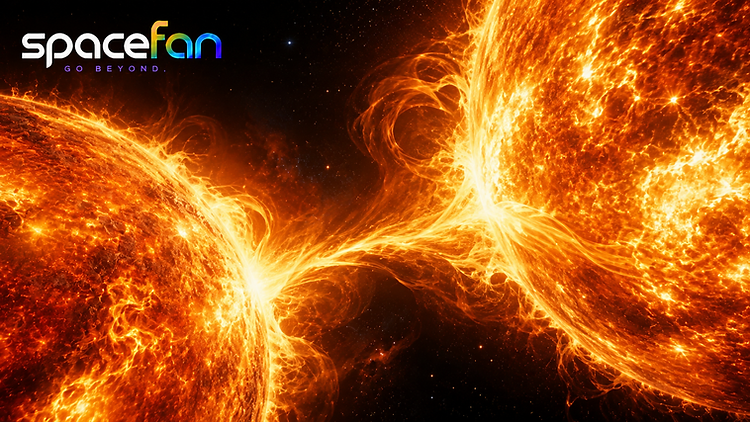
Two fiery stars interacting through huge glowing loops and streams of stellar plasma.
Image · Space.Fan

The Drop

Space is filled with strange, short flashes of radio waves called Fast Radio Bursts, or FRBs. Some of these signals happen only once, but others repeat over and over from the same spot in the sky. For a long time, scientists have been puzzled by why these repeating signals act so differently from one another. Researchers have now linked these pulses to young, powerful s called s that are surrounded by the remains of a recent explosion. By studying these signals, the team discovered that these s sit inside binary systems, where two s orbit each other. The team looked at five different repeating FRB sources and found they all seem to share this same family structure. They believe that the leftover debris from the 's death creates a cloud that changes how the radio signals travel to us. As the gets older and calmer, the brightness of the signal changes, which explains why some bursts look different than others.
Advertisement

Why It Matters

This new model is important because it connects many separate observations into one clear story. Before this, scientists struggled to explain why the radio signals from these objects varied so much over time. By proving that a young in a messy, active environment is likely the source, researchers can now predict how these signals might change in the future.
Advertisement

The Catch

While this model fits the data very well, it is still a theory based on our current understanding of these objects. It is hard to see these faraway s directly because they are hidden behind layers of gas and dust from the exploded . Scientists need more observations of other repeating bursts to make sure this explanation works for every single one found in the sky.

Put That in Perspective

Astronomers plan to keep watching these sources over the next few years. They want to see if the signals fade exactly how the model predicts as the magnetars continue to age.

Source September 29, 2026
ApJ

Keep Exploring Space