Advertisement
Space.Fan — Go Beyond
ApJ · 10 HR AGO
Sun & Space WeatherSIMULATION

Solving the Mystery of the Sun’s Hottest Cold Layer

By Space.Fan Editorial Desk

New computer models explain why a chilly part of the Sun’s atmosphere is much hotter than it should be.
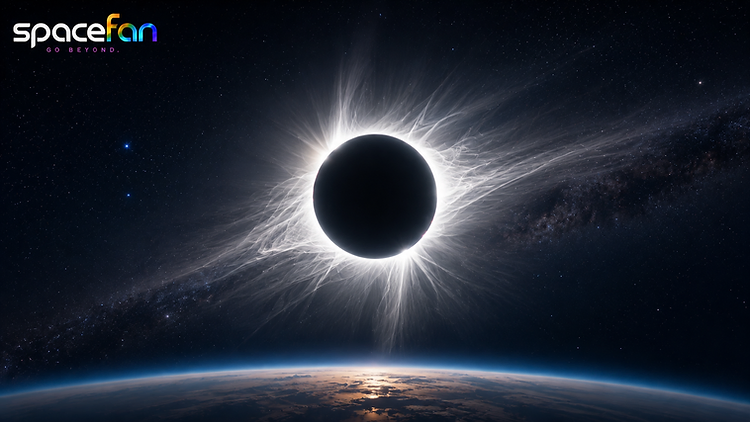
Total solar eclipse with a brilliant white corona suspended above the curved horizon of Earth viewed from space.
Image · Space.Fan

The Drop

The Sun has an outer layer called the chromosphere. While this area is supposed to be one of the cooler parts of the Sun, scientists have long noticed that it is surprisingly hot. For a long time, researchers could not figure out why the temperatures here did not match their computer models. Now, a new study suggests that a specific type of plasma movement called the Thermal Farley-Buneman Instability is to blame. This event happens at a very small scale, almost like tiny, invisible whirlpools of electricity and gas. Scientists used advanced computer simulations to see how these small movements act across the different conditions found in the Sun’s atmosphere. They discovered that these tiny plasma instabilities act like a heater, taking energy from the flow of gas and turning it into heat. The simulation showed that when these instabilities are active, the temperature of charged particles in the area jumps up significantly. This process also creates tiny, swirling motions that move energy around in ways we have never fully mapped before. By looking at how these instabilities change the current of electricity inside the plasma, the team found a strong link between these invisible forces and the mysterious heating of the solar atmosphere.
Advertisement

Why It Matters

This discovery helps bridge a major gap between what we see on the Sun and what our math says should happen. By showing that these small-scale plasma movements are responsible for the extra heat, scientists can now make more accurate models of the Sun’s behavior. This matters because understanding how the Sun heats its atmosphere helps us better predict space weather that can affect satellites and power grids here on Earth.
Advertisement

The Catch

This work is based entirely on computer simulations. While these models are very detailed, they cannot account for every single atom or movement happening on the massive, chaotic surface of the Sun. Because of this, scientists still need to observe these tiny instabilities in real-time with future, high-resolution telescopes to confirm that these simulations perfectly match what is happening in space.

Put That in Perspective

Scientists have been trying to solve the problem of solar heating for decades. While earlier studies focused on large-scale magnetic fields, this research highlights how tiny, local events can have a huge impact on the overall temperature of the Sun. Next, researchers will likely look for ways to confirm these findings using next-generation solar observatories.

Source September 26, 2026
ApJ

Keep Exploring Space