Advertisement
Space.Fan — Go Beyond
ApJ · 3 HR AGO
Sun & Space WeatherPEER REVIEWED

Sunspots Fade on Their Own, New Study Suggests

By Space.Fan Editorial Desk

Scientists found that the way a sunspot disappears is likely caused by the sunspot itself, not the solar weather happening around it.
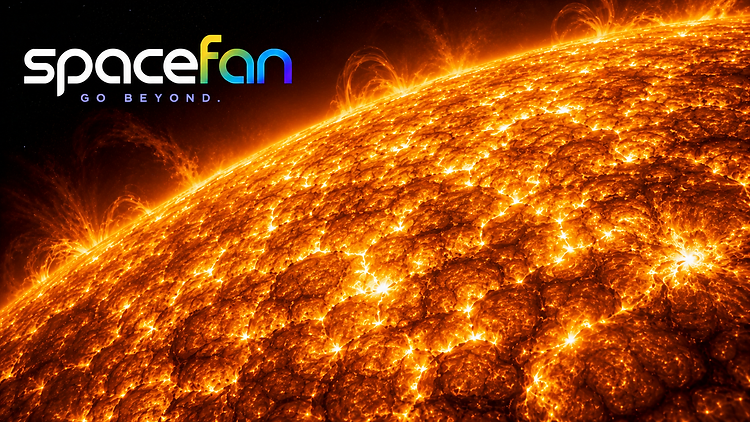
Close-up of the fiery Sun showing bright active regions and looping plasma above its surface.
Image · Space.Fan

The Drop

Sunspots are dark, cool areas on the surface of the Sun caused by strong magnetic fields. Over time, these spots change shape and eventually fade away. Scientists have long wondered if the activity around a sunspot helps it fade faster or if the sunspot decides its own fate. To find out, researchers looked at data from the Helioseismic and Magnetic Imager on the Solar Dynamics Observatory satellite. The team picked 10 different sunspots that were fading at different speeds. They measured the magnetic strength inside the sunspot and the magnetic turbulence, or 'noise,' in the area right around it. If the surrounding area was messy and turbulent, they wanted to see if that made the sunspot shrink more quickly. After comparing the data, the researchers found no connection between the outside turbulence and how fast the sunspot faded. Even if the surrounding area was very active and choppy, it did not seem to change the sunspot's life cycle. This suggests that the reasons a sunspot disappears are internal and happen inside the spot itself rather than being pushed along by outside forces.
Advertisement

Why It Matters

This discovery helps solar physicists focus their research. By ruling out the surrounding magnetic environment, scientists now know that the secrets of a sunspot’s decay are hidden within the core of the spot. This allows them to create better computer models of how the Sun's magnetic field changes over time.
Advertisement

The Catch

The study looked at a sample of 10 active sunspot regions. While this was enough to find a pattern, it is a small group. Researchers will need to study many more sunspots over a longer period to be sure this rule applies to all types of sunspots across the entire surface of the Sun.

Put That in Perspective

Scientists have tracked sunspots for hundreds of years, but the high-tech sensors on modern space telescopes like the SDO allow us to see the magnetic structure of these spots in amazing detail for the first time. Future studies will likely look at whether even older or larger sunspots follow this same pattern of self-determined fading.

Source September 26, 2026
Valentina Abramenko, Olga K. Kutsenko, and Andrey Plotnikov
Crimean Astrophysical Observatory·The Astrophysical Journal·10.3847/1538-4357/ae9eb1

Keep Exploring Space