Advertisement
Space.Fan — Go Beyond
Universe Today · 5 DAYS AGO
UniversePEER REVIEWED

Telescope Detects Faint Whispers of Gas from the Early Universe

By Space.Fan Editorial Desk

Astronomers used a giant radio telescope to catch the hidden signal of hydrogen gas from billions of years ago.
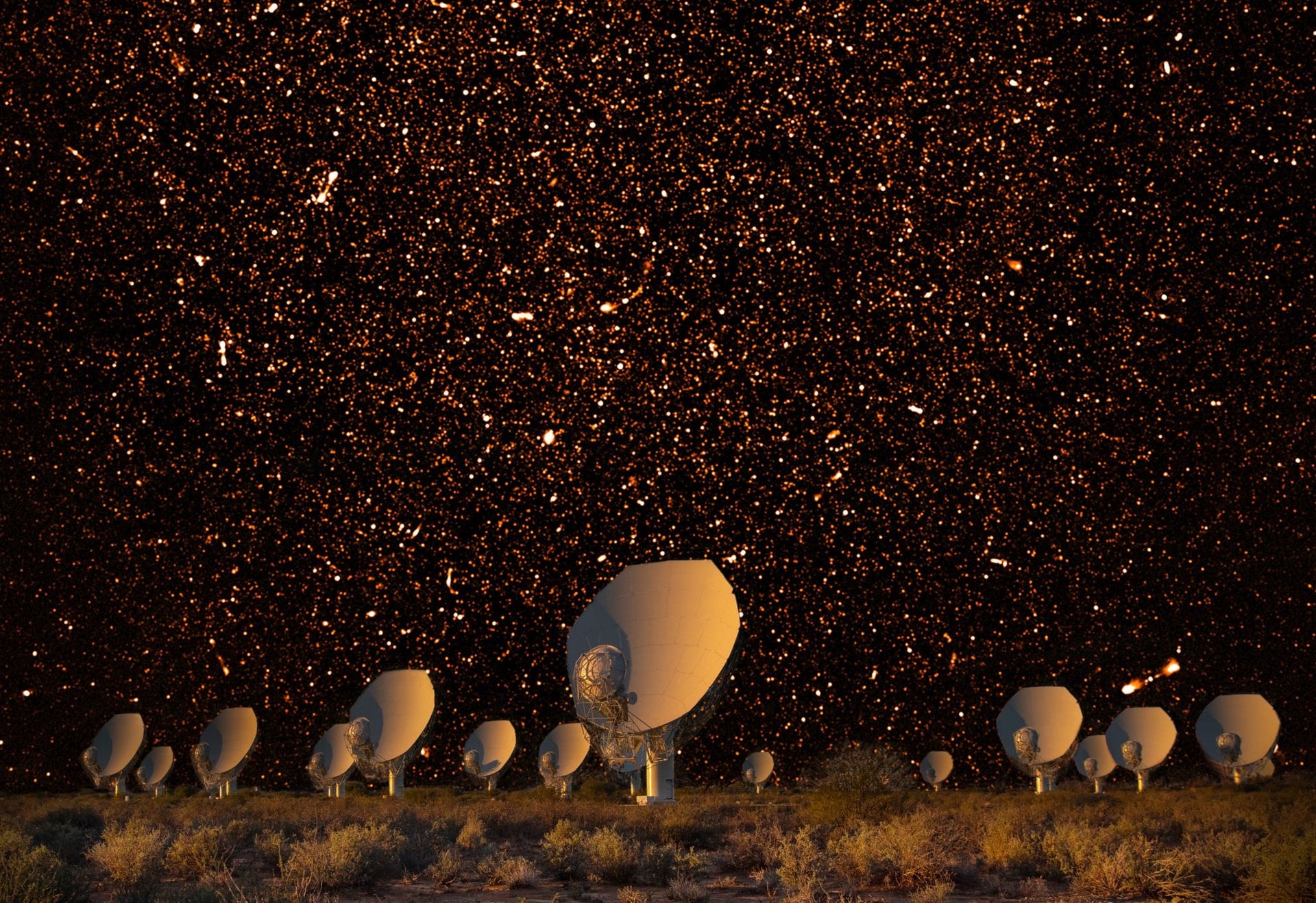
A group of large white radio telescope dishes pointing toward the dark night sky.
Image · Universe Today

The Drop

Scientists have found a brand-new way to map the history of our universe. Using a powerful tool called the MeerKAT radio telescope in South Africa, researchers successfully picked up a very weak radio signal from hydrogen gas. This gas is located between 3.6 and 4.7 billion light-years away. It tells us what the universe looked like when it was much younger. The method used is called Hydrogen Intensity Mapping. Instead of trying to take a picture of every single galaxy in the sky, astronomers measure the combined glow of all the hydrogen gas in a large area. This gas is the main building block for stars and galaxies. Because the universe is always stretching out, the radio signals from this gas get stretched too, which helps scientists figure out exactly how far away the gas is. This discovery is special because the team pulled the signal from old data that had been sitting in storage since 2018. They had to be very careful to separate the faint cosmic signal from human-made radio noise on Earth. Proving that this technique works with a single telescope is a huge win for future science projects.
Advertisement

Why It Matters

This technique makes it much faster and cheaper to map the giant structure of our universe. Because it does not require seeing every single galaxy, it allows scientists to look at huge chunks of space at once. This will help them understand how dark matter and dark energy pull on the cosmic web, acting like invisible glue that shapes everything we see in space.
Advertisement

The Catch

While this is a great step forward, the signal the researchers found is incredibly quiet. It is very hard to separate this signal from the much louder radio noise created by human technology and even our own galaxy. Because the data was old, researchers also had to work extra hard to make sure the signal was real and not just a glitch in the equipment.

Put That in Perspective

In the past, scientists often had to combine data from many different types of telescopes to understand these regions. This new result shows that the MeerKAT telescope can do this work on its own. It serves as a test run for the massive Square Kilometer Array, a future telescope project that will be even better at mapping the entire sky.

Source September 6, 2026
Sourabh Paul, Laura Wolz, Zhaoting Chen
University of Manchester, University of the Western Cape, University of Edinburgh, SARAO, McGill University·The Astrophysical Journal Letters

Keep Exploring Space