Advertisement
Space.Fan — Go Beyond
ApJ · 2 DAYS AGO
UniversePEER REVIEWED

Webb Telescope Finds Ancient Galaxies Bunching Together in the Early Universe

By Space.Fan Editorial Desk

New deep-space images reveal that the very first bright galaxies were much more social than our computer models predicted.
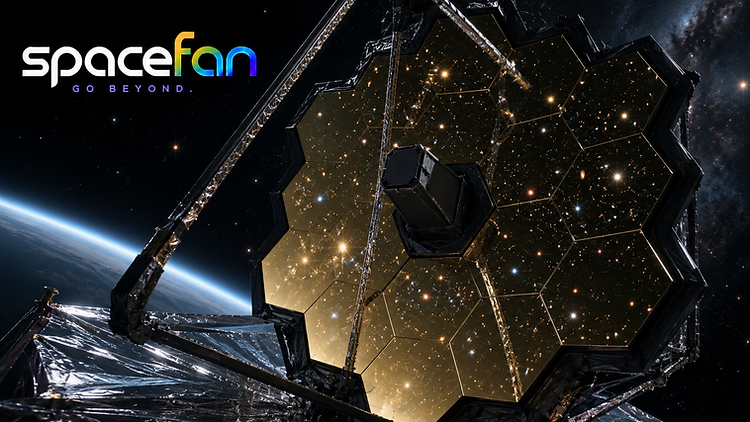
James Webb Space Telescope in space with its gold segmented mirror facing the stars.

The Drop

Astronomers using the James Webb Space Telescope have been looking back in time at the very first galaxies that formed after the Big Bang. By using a special survey called BEACON, the team took pictures of 36 different patches of the deep sky. This allowed them to spot 164 distant galaxies that existed when the universe was less than a billion years old. Because these galaxies are so far away, their light has been traveling for a very long time before reaching our mirrors. By analyzing this light, the researchers could measure how bright these galaxies were and how they were spread out across space. They found something surprising: these bright, early galaxies were not spread out evenly. Instead, they were often found living in crowded groups, or clusters. This discovery shows us that even in the very early universe, the pull of gravity was already bringing galaxies together into tight neighborhoods.
Advertisement

Why It Matters

Before this, scientists used computer models to guess how galaxies would act in the early universe. The new data shows that these bright galaxies are clustering together more than those old models suggested. This implies that these galaxies likely live inside much larger "halos" of invisible dark matter than we previously thought. Understanding this helps researchers fix their computer models so they can more accurately predict how the universe grew from a simple soup of gas into the web of s and galaxies we see today.
Advertisement

The Catch

While these findings are exciting, there is still some uncertainty. The survey covers a small portion of the sky, which means it might not show us the full picture of the early universe. Because we are looking at such tiny, faint objects at the edge of the observable universe, it is hard to know for sure exactly how massive their dark matter halos are. The researchers are still working to refine their models to see if there are other ways to explain why these galaxies look so bunched together.

Put That in Perspective

Scientists have known for a long time that galaxies cluster together, but seeing it happen so soon after the universe began is a major step. Researchers now plan to use these observations to compare how galaxies grew at different times in history, helping us build a better timeline of our cosmic history.

Source September 23, 2026
Kimi C. Kreilgaard, Charlotte A. Mason, Takahiro Morishita, Yechi Zhang, Viola Gelli, Nicha Leethochawalit, Tommaso Treu, Michele Trenti, Abdurro’uf, Hakim Atek
Cosmic Dawn Center, Niels Bohr Institute, University of Copenhagen, IPAC, California Institute of Technology, Tohoku University, National Astronomical Research Institute of Thailand, University of California, Los Angeles, The University of Melbourne, Indiana University, Institut d’Astrophysique de Paris, University of Ljubljana, University of California Davis, Space Telescope Science Institute, University of Oxford·The Astrophysical Journal·10.3847/1538-4357/ae9152

Keep Exploring Space