
Advertisement
Space.Fan — Go Beyond
ApJ · 4 HR AGO
DiscoveriesPEER REVIEWED

Webb Telescope Peers into the Atmosphere of a Strange Space Duo

By Space.Fan Editorial Desk

Astronomers used the James Webb Space Telescope to study how heat moves across a giant, distant world locked in a dance with a dead star.
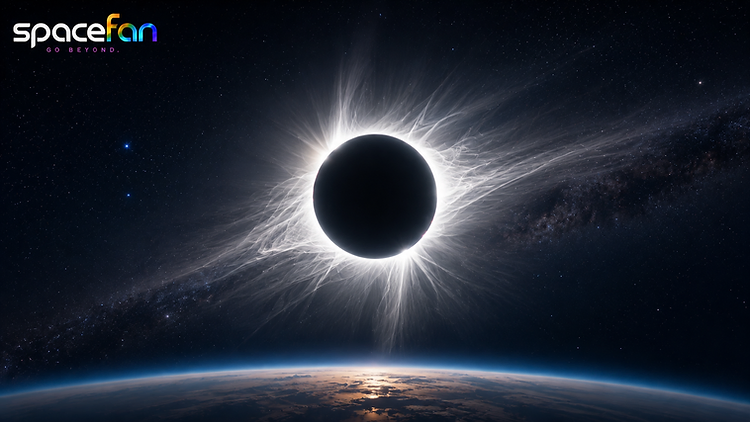
Total solar eclipse with a brilliant white corona suspended above the curved horizon of Earth viewed from space.
Image · Space.Fan

The Drop

Scientists have taken a close look at a pair of objects spinning around each other in deep space. The pair consists of a white dwarf, which is the remains of a dead , and a brown dwarf, which is a massive object that is larger than a but smaller than a typical . Because they are locked in a very tight orbit, the brown dwarf is stuck with one side always facing the dead . This is similar to how the always shows the same face to Earth. To study this, the team used the powerful James Webb Space Telescope (JWST). They watched the pair for a full orbit. As the brown dwarf moved, the telescope captured light from its surface. By looking at how the light changed, researchers were able to separate the heat coming from the brown dwarf from the light of the dead . This is the first time scientists have been able to get such a detailed look at this type of system. The most interesting result was how poorly the brown dwarf moves heat around. Usually, winds on such worlds should blow heat from the hot side to the cold side. However, the data shows that less than 10 percent of the heat makes it to the night side. The telescope also found a surprising amount of carbon dioxide gas on the dark side of the brown dwarf, which reveals even more about its strange, layered atmosphere.
Advertisement

Why It Matters

This study helps scientists understand how atmospheres work on objects that are not quite s and not quite s. By seeing how heat gets trapped or moved on this brown dwarf, experts can improve the computer models they use to study distant s. Furthermore, this system serves as a time machine for how solar systems change. Since the white dwarf used to be a normal like our Sun, watching this pair helps us learn what happens to s and other objects when their parent dies and shrinks down.
Advertisement

The Catch

While the data is very clear, it relies on complex models to interpret what the telescope sees. Scientists cannot physically visit these objects, so they must use math to guess what the gases are doing. Additionally, while they found that heat does not move well, there could be other factors like clouds or magnetic fields that the current models might be missing or underestimating.

Put That in Perspective

This discovery offers a bridge between the study of giant gas planets and the study of tiny stars. Researchers plan to use these results to better compare the atmospheres of different worlds across the galaxy to see if this type of heat-trapping is common or rare.

Source September 25, 2026
Daphne Broski-Laing, Yifan Zhou, Joshua D. Lothringer, Daniel Apai, Jenni R. French, Sarah L. Casewell, L. C. Mayorga, Lael Shin, Ben W. P. Lew, Xianyu Tan, Vivien Parmentier, Siyi Xu, Mark S. Marley
University of Virginia, Space Telescope Science Institute, University of Arizona, University of Birmingham, University of Leicester, Johns Hopkins University Applied Physics Laboratory, Bay Area Environmental Research Institute, NASA Ames Research Center, Shanghai Jiao Tong University, Observatoire de la Côte d’Azur, NSF NOIRLab·The Astrophysical Journal·10.3847/1538-4357/ae9940

Keep Exploring Space