Advertisement
Space.Fan — Go Beyond
ApJ · 10 HR AGO
UniversePEER REVIEWED

Webb Telescope Peers into the Early Universe to Study Massive Black Holes

By Space.Fan Editorial Desk

Astronomers used the James Webb Space Telescope to observe 27 glowing quasars and how they grow in the early universe.
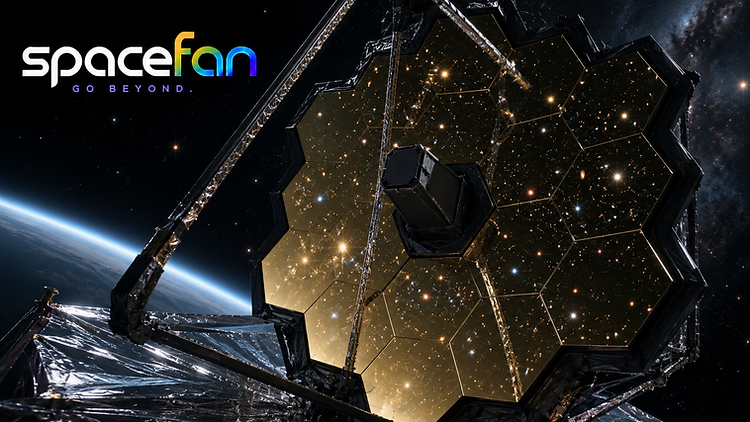
James Webb Space Telescope in space with its gold segmented mirror facing the stars.
Image · Space.Fan

The Drop

Astronomers have used the James Webb Space Telescope to take a closer look at 27 quasars. Quasars are incredibly bright objects powered by supermassive s sitting in the centers of galaxies. These specific s are very old, existing when the universe was less than a billion years old. Because they are so far away, the light we see left them billions of years ago. To study these giants, the team used an instrument called the NIRSpec integral field unit. This tool acts like a camera that can measure light at every single point in its field of view. By breaking down the light into its rainbow of colors, researchers can tell what the gas around the is doing. The study found that these early s are growing very quickly. Some of the quasars showed signs of powerful winds, or outflows, blowing gas away from their centers. In some cases, the team spotted shapes that suggest these galaxies might be crashing into each other or are filled with messy, clumpy clouds of gas. Overall, the s in the early universe seem to behave a lot like the ones we see in our own cosmic neighborhood today. This helps scientists understand how these objects were able to get so big so fast shortly after the Big Bang occurred.
Advertisement

Why It Matters

Understanding how supermassive s grew to such massive sizes early in the universe is a major puzzle in space science. This research confirms that many of the rules we use to study s nearby also work for the very distant, ancient ones. It helps scientists rule out some theories about how these s formed by showing that their growth processes were already established very early on.
Advertisement

The Catch

While the results are exciting, they come with some uncertainty. The data shows some shapes that look like two galaxies merging, but it is hard to be sure if that is what is happening. It is possible the light we see is just the pushing on the gas in its host galaxy. Because these objects are so far away, we are limited by the detail we can see, and some differences from nearby s might just be measurement errors.

Put That in Perspective

Before the James Webb Space Telescope, it was very difficult to get this much detail on such distant objects. This study provides a vital look at the environment surrounding black holes in the infant universe, giving astronomers a new baseline to compare future observations against as they look for even older, more mysterious structures.

Source September 25, 2026
ApJ

Keep Exploring Space