Advertisement
Space.Fan — Go Beyond
AJ · 12 MIN AGO
DiscoveriesPEER REVIEWED

A New AI Tool Helps Scientists Find Hidden Earth-Like Planets

By Space.Fan Editorial Desk

A smart computer program named AESTRA is helping astronomers filter out sun noise to spot tiny, distant worlds.
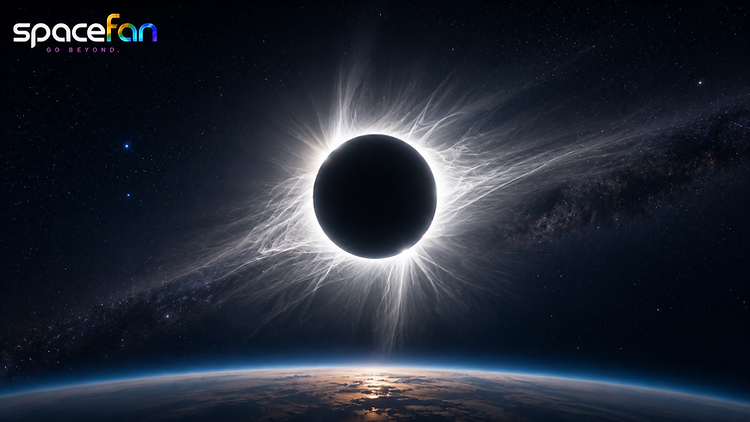
Total solar eclipse with a brilliant white corona suspended above the curved horizon of Earth viewed from space.
Image · Space.Fan

The Drop

Finding s like Earth is very difficult because s are noisy. A ’s natural surface activity, like bright spots or boiling gas, creates patterns that can hide the tiny gravitational tug of an orbiting . Astronomers usually look for these s by measuring a 's wobble, but until now, the noise from the often drowned out the signal of small s. A team of researchers has created a new computer tool called AESTRA to solve this problem. It acts like a digital filter that cleans up the noisy data we get from telescopes. Instead of needing extra instructions, AESTRA learns to separate the ’s own flickering light from the signals that might be caused by a . The team tested their program using data from the NEID instrument, which looks at our Sun as if it were a distant . By using AI to clean the data, they were able to spot s that older methods completely missed. In tests where they hid 500 fake s in the data, AESTRA was much better at finding the small ones compared to traditional methods.
Advertisement

Why It Matters

This development is a big deal because it makes our -hunting tools much more sensitive. Being able to detect very small signals allows astronomers to find smaller, rocky s that are similar to Earth. This is a crucial step if we ever want to find worlds that could potentially support life.
Advertisement

The Catch

While the tool is powerful, it is still a computer model that relies on training data. It might not work perfectly on every type of , especially ones that act very differently from our Sun. The researchers need to keep testing the program to ensure it doesn't accidentally invent "ghost" s that aren't actually there.

Put That in Perspective

In the past, finding small planets around stars required a massive amount of luck and very expensive equipment. Tools like this represent the future of astronomy, where artificial intelligence helps scientists sift through vast amounts of information to find the smallest secrets hidden in the stars.

Source November 24, 2026
Yan Liang, Joshua N. Winn, Peter Melchior, Sicong Lu, Quang H. Tran
Princeton University, Yale University, University of Pennsylvania·The Astronomical Journal·10.3847/1538-3881/aebc52

Keep Exploring Space