Advertisement
Space.Fan — Go Beyond
ApJ · 5 HR AGO
DiscoveriesMODEL

A New Digital Map for Studying Brown Dwarf Atmospheres

By Space.Fan Editorial Desk

Researchers have created a powerful new tool to help scientists decode the messy, cloudy atmospheres of mysterious objects called brown dwarfs.
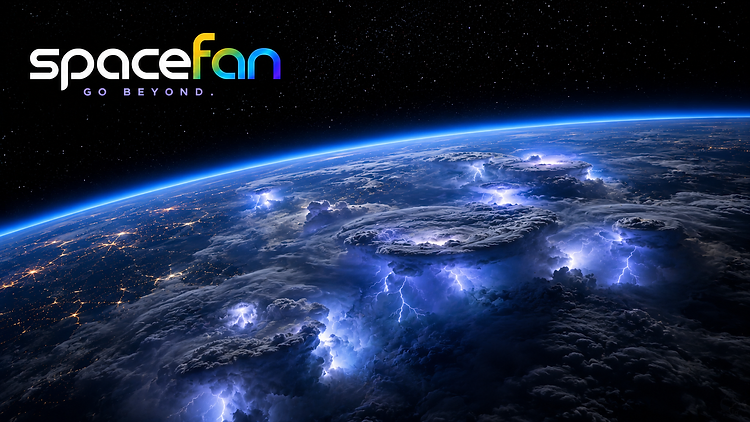
Massive thunderstorms flashing with lightning across Earth's cloud-covered atmosphere as seen from space.
Image · Space.Fan

The Drop

Brown dwarfs are strange objects that sit somewhere between a giant and a . Because they do not shine like true s, studying them is very difficult. Their atmospheres are filled with complex clouds made of dust and minerals that block our view, making it hard for telescopes to see what is happening deep inside. To solve this, a team of researchers built a new library of computer models that act like a translation guide for space observations. This library provides a detailed look at how heat and light escape through the clouds of a brown dwarf. By comparing these computer patterns to actual light captured by telescopes, scientists can better understand the weather and temperature on these distant worlds. The project used advanced code to simulate different types of atmospheres, ranging from 500 to 2000 degrees Kelvin. These simulations account for various cloud types and different gas mixtures to help astronomers see through the haze. Scientists can now use a new web application provided by the team to match their telescope data against these pre-made models, saving them a massive amount of time when planning their studies. This work covers a broad range of light wavelengths, from 0.5 to 30 micrometers, which is perfect for looking at the infrared light these objects give off.
Advertisement

Why It Matters

This new tool is a big deal because it takes the guesswork out of interpreting space data. In the past, scientists had to build their own complex models from scratch every time they looked at a new brown dwarf. By offering a standardized set of models, this research allows different teams around the world to compare their findings on the same scale. It specifically helps researchers identify the signatures of important gases like methane and carbon dioxide even when thick, swirling clouds try to hide them.
Advertisement

The Catch

While this tool is incredibly helpful, it is still a model. It relies on specific scientific assumptions about how gases and dust behave in extreme heat. If the real-world chemistry inside a brown dwarf is different from what we currently understand, the model might not be perfectly accurate. Also, it focuses on atmospheres that are in chemical balance, which might not always represent the chaotic, changing weather patterns we actually see in nature.

Put That in Perspective

Astronomers have long struggled to piece together the life story of brown dwarfs as they cool down over time. This new resource, which is now open for public use, is the latest step in making space science more accessible and efficient. Researchers will likely use these tools next to better interpret data coming from large infrared space telescopes to learn more about the transition from star-like behavior to planet-like behavior.

Source October 3, 2026
Myrla Phillippe, Theodora Karalidi, Elena Manjavacas, Natalia Oliveros Gomez, Daniel Apai, Jonathan Fernandez, Kieran M Manjrawala
University of Central Florida, Space Telescope Science Institute, Johns Hopkins University, University of Arizona·The Astrophysical Journal·10.3847/1538-4357/aea222

Keep Exploring Space