Advertisement
Space.Fan — Go Beyond
ApJS · 4 HR AGO
Sun & Space WeatherPEER REVIEWED

A New Math Formula Helps Predict Solar Wind Speeds

By Space.Fan Editorial Desk

Scientists have created a new, smarter way to predict how fast solar wind blows toward Earth using artificial intelligence.
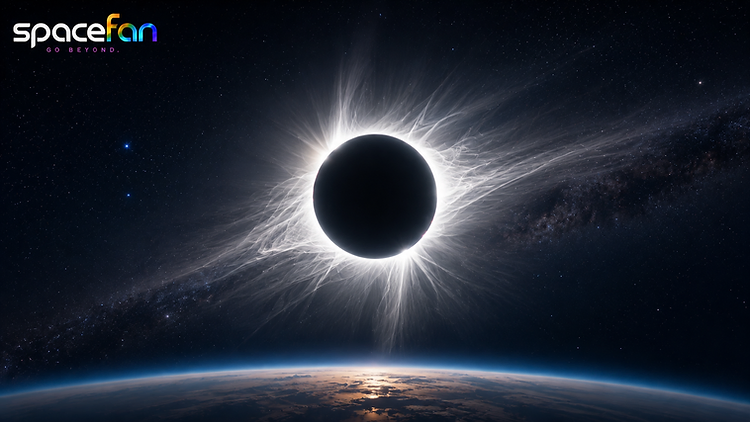
Total solar eclipse with a brilliant white corona suspended above the curved horizon of Earth viewed from space.
Image · Space.Fan

The Drop

Our Sun is constantly sending out a stream of particles called solar wind. Sometimes, this wind travels very fast, and when it hits Earth, it can affect our satellites and power grids. To better protect our technology, scientists are looking for ways to predict these speed changes before they arrive. Recently, researchers used a special type of computer program to find a better way to guess the speed of this solar wind. They used data from a space telescope called the Solar Dynamics Observatory to look at dark patches on the Sun known as coronal holes. These patches are where the fastest solar wind usually comes from. By feeding years of information about these patches into a program called symbolic regression, the team found a new math formula that describes how the wind speed changes. This formula looks at how big the dark holes are and how they look compared to their surroundings. By testing this formula against past records, they found it works better than the older tools we have used for years. It breaks the wind speed down into two main parts: one that describes how the holes speed up the wind, and another that looks at how the wind has been behaving over the last few weeks.
Advertisement

Why It Matters

Being able to predict solar wind speed helps us prepare for space weather that can interfere with GPS and radio signals. Because this new formula is based on clear math, it is easier for scientists to understand why the solar wind is speeding up or slowing down. It acts like a more accurate weather report for space, which is essential for keeping our satellites and power lines safe from solar interference.
Advertisement

The Catch

While this new formula is an improvement, it is not perfect. It still struggles to be completely accurate all the time, as shown by its error rate when compared to real-world measurements. The formula also relies heavily on how coronal holes look, but solar wind can be influenced by many other complex factors on the Sun that the current model does not fully track.

Put That in Perspective

Scientists have tracked solar wind for decades, but modern computing is finally helping us turn massive amounts of data into simple, reliable rules. Future research will likely focus on adding more solar data to the formula to see if it can become even more precise during different times of the solar cycle.

Source September 27, 2026
ApJS

Keep Exploring Space