Advertisement
Space.Fan — Go Beyond
ApJS · 1 DAY AGO
Sun & Space WeatherSIMULATION

Solving the Mystery of What Triggers Giant Solar Eruptions

By Space.Fan Editorial Desk

Scientists have uncovered why some magnetic loops on the Sun burst outward to create massive solar eruptions, helping us better predict space weather.
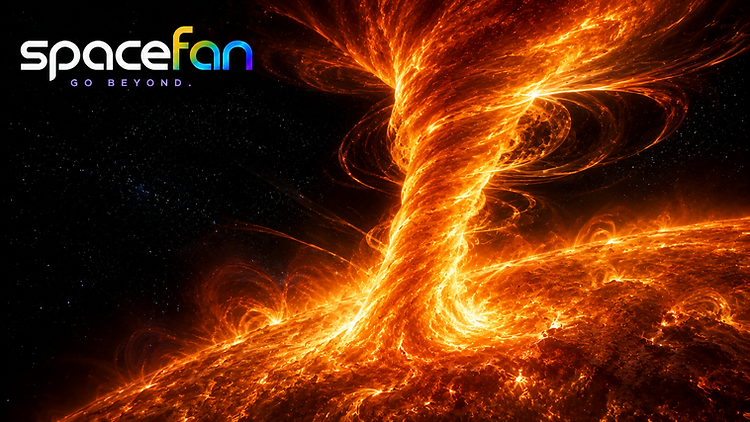
Huge twisting prominence of glowing plasma erupting above the surface of the Sun.
Image · Space.Fan

The Drop

Our Sun is covered in magnetic loops that hold onto plasma. Sometimes, these loops become unstable and snap, sending huge amounts of energy and material out into space. This is what we call a solar eruption. For a long time, scientists have suspected that a specific trigger called 'torus instability' is responsible for these eruptions, but they struggled to pin down exactly when it happens. To understand this better, researchers used powerful computer simulations to mimic these magnetic structures on the Sun. They created a digital model of a magnetic 'flux rope,' which is essentially a twisted rope of magnetic field lines. By testing different magnetic environments, the team looked for the breaking point where these ropes fly off into space. They found that the threshold for this instability changes based on the surrounding magnetic field. When the 'strapping field'—the magnetic blanket holding the rope down—decays at a certain rate, the loop becomes unstable. The team discovered that their simulations align well with the math used to predict these events, confirming that the way the Sun's magnetic field is shaped plays a massive role in whether an eruption will occur.
Advertisement

Why It Matters

Understanding the exact tipping point of solar eruptions is vital for protecting our technology. When these explosions head toward Earth, they can cause solar storms that disrupt satellite signals, power grids, and radio communication. By identifying the 'breaking point' of magnetic fields, scientists can create better models to forecast when the Sun might launch a dangerous storm toward our .
Advertisement

The Catch

This study relies on computer simulations rather than live observations of a single solar event. While the math matches what we see on the Sun, real-world solar environments are incredibly complex and involve many moving parts that are hard to capture perfectly in a computer program. The results reflect idealized conditions, and actual solar eruptions may have additional factors that the model did not account for.

Put That in Perspective

Astronomers have long debated why the threshold for these solar events seemed to vary in different observations. This study provides a missing link, showing that things like an 'external toroidal field' can make the magnetic loops much more stable than previously thought. Future research will likely focus on applying these findings to live data from solar observatories to see if we can predict the onset of storms with more accuracy.

Source September 27, 2026
ApJS

Keep Exploring Space