Advertisement
Space.Fan — Go Beyond
ApJ · 2 HR AGO
UniverseSIMULATION

A New Way to Map Invisible Gravitational Waves Using Pulsars

By Space.Fan Editorial Desk

Scientists have created a better map for finding faint ripples in space-time by listening to the rhythmic ticking of cosmic clocks.

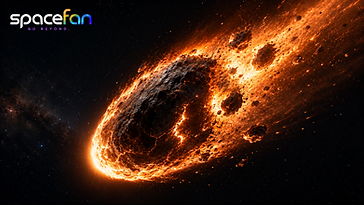
A meteor streaking across the sky above city lights.
Image · Space.Fan

The Drop

Space is not just empty. It is filled with giant ripples called gravitational waves. These waves are caused by massive events, like s crashing into each other. For a long time, it has been hard to pinpoint exactly where these waves are coming from in the sky. Researchers have now developed a new, more precise way to create maps of these waves using pulsars. Pulsars are spinning dead s that act like perfect cosmic clocks. They send out regular pulses of radio waves that reach Earth with incredible timing. When a gravitational wave passes between a pulsar and Earth, it slightly changes the timing of those pulses. By studying many pulsars together, which we call a Pulsar Timing Array, scientists can detect these hidden ripples. This new method is special because it does not just see the strength of the wave. It also keeps track of the wave's phase and its hidden shape, known as polarization. It is like moving from a blurry black-and-white photo to a clear, high-definition 3D map. This gives researchers a complete picture of the gravitational wave sky, showing exactly where the signals t and what direction they are moving. The team tested their idea by running computer simulations. They used different arrangements of pulsar arrays and added noise to see if their method could still find the right signals. The test was a success, as the framework was able to accurately find the location and strength of simulated waves even in difficult conditions.
Advertisement

Why It Matters

This new tool is a major step forward for how we study the universe. Before this, scientists had to use different, complicated steps to figure out where signals came from. This unified framework simplifies the process by combining everything into one clear, smart system. It allows astronomers to distinguish between the background hum of many distant waves and specific, loud events happening nearby. By cleaning up the data, this method helps us better understand the nature of gravity and the objects in the deep universe that are too far away for light-based telescopes to see.
Advertisement

The Catch

While this new framework looks great in computer simulations, it has not yet been used on real, messy data from the actual sky. The real universe is much more complicated than a computer model. The team notes that things like the way an array is set up and the natural noise from the pulsars themselves could still make it difficult to see perfect images of the gravitational wave sky.

Put That in Perspective

Scientists have spent years gathering data from pulsars to find these tiny ripples. This new mathematical approach will be the next step for researchers working with existing pulsar arrays to turn years of collected data into the first detailed maps of the gravitational wave universe.

Source September 26, 2026
ApJ

Keep Exploring Space