Advertisement
Space.Fan — Go Beyond
ApJ · 1 DAY AGO
Sun & Space WeatherSIMULATION

A New Way to Model Solar Wind Helps See the Sun More Clearly

By Space.Fan Editorial Desk

Scientists have created a better digital tool to map the Sun's magnetic winds, making our space weather predictions more accurate than ever.
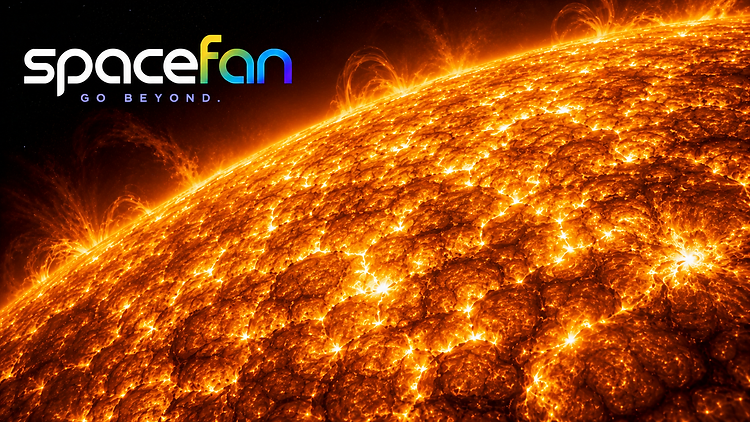
Close-up of the fiery Sun showing bright active regions and looping plasma above its surface.
Image · Space.Fan

The Drop

Space is filled with invisible energy flowing from the Sun, known as the solar wind. This wind is made of charged particles that move through magnetic fields. For years, scientists have used computer programs to simulate how this wind moves, but these models sometimes make small errors when the magnetic fields flip or change direction. This makes it hard to see the true structure of the Sun's outer layers. Researchers have now developed a new, improved method for these simulations. By changing how the computer calculates the way magnetic fields act at the edges of solar regions, they have created a much smoother and more reliable map. This new tool, called the NPP-POS method, acts like a sharper lens for space scientists. Instead of getting blurry data when magnetic fields rotate, the computer can now follow the twists and turns of the solar wind much more accurately. The team tested their new method by running a simulation of a specific period of solar activity known as CR 2193. They compared the results to actual pictures and data collected from space. The new model did a better job of showing the thin layers where the solar magnetic field flips, helping scientists get a clearer look at the Sun's environment.
Advertisement

Why It Matters

Understanding the solar wind is critical because it carries magnetic energy that can interact with Earth's own magnetic field. When the solar wind is messy or unpredictable, it can trigger space weather events that might disrupt satellites or radio communications. By sharpening our models, we can better predict how these solar magnetic waves will travel through the solar system. This helps us better prepare for space weather that could affect our technology here on Earth.
Advertisement

The Catch

This research is based on a computer simulation rather than a physical experiment in space. While the team checked their work against real data, the model is still a mathematical approximation. It does not perfectly capture every single detail of the Sun's complex atmosphere, and it may not perform the same way under all different types of solar conditions.

Put That in Perspective

Scientists have been trying to model solar wind for decades, but it remains one of the hardest things to simulate because of its massive scale. This new method is a step forward in bridge-building between complex math and real-world observation. Future research will likely test this method against different solar cycles to see if it remains accurate as the Sun's activity levels change over time.

Source October 2, 2026
Caixia Li, Jiachun Xu, Zhenning Shen, Xueshang Feng
Shenzhen Technology University, Macau University of Science and Technology, National Space Science Center, Chinese Academy of Sciences, Harbin Institute of Technology·The Astrophysical Journal·10.3847/1538-4357/aea136

Keep Exploring Space