Advertisement
Space.Fan — Go Beyond
ApJS · 13 HR AGO
Sun & Space WeatherPEER REVIEWED

New AI Sharpens Views of the Sun Through Blurry Earth Air

By Space.Fan Editorial Desk

Scientists have created a smart computer program that fixes blurry images of the Sun taken from ground-based telescopes.
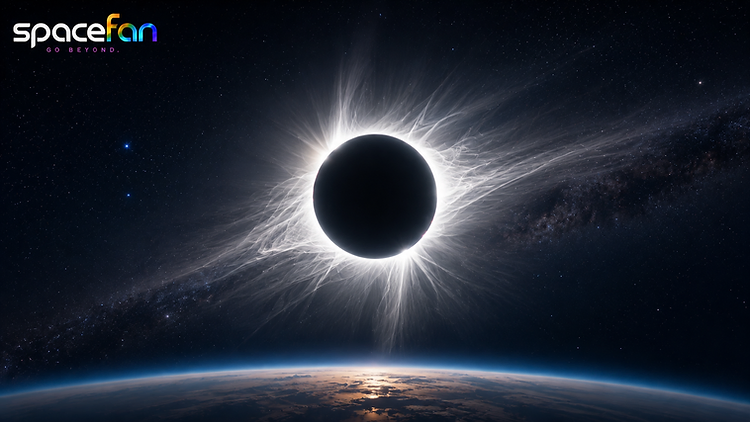
Total solar eclipse with a brilliant white corona suspended above the curved horizon of Earth viewed from space.
Image · Space.Fan

The Drop

Looking at the Sun from Earth is difficult because our atmosphere is always moving. This air creates swirling patterns that make images of the Sun look wavy and blurry, almost like looking at a coin at the bottom of a splashing swimming pool. Astronomers have struggled to fix these images because it is hard to separate the real features of the Sun from the blurry interference caused by the air. A team of researchers built a new computer system to solve this. They used a special kind of artificial intelligence that learns how to spot and remove these blurry patterns. Instead of needing extra sensors to measure the air, this program looks at the blurry pictures themselves and figures out what the original image should look like. The system works by using a smart model that knows the rules of physics. It acts like a digital lens that cleans up the view in real-time. By testing it with thousands of simulated solar images, the team taught the computer how to reconstruct clear, sharp pictures without needing special equipment or extra guide s.
Advertisement

Why It Matters

This technology is a big deal for ground-based telescopes. Usually, building telescopes with high-end sensors to fix air blur is very expensive and difficult. This new method means scientists can get much clearer data from existing telescopes without needing to upgrade the hardware. It makes studying the Sun easier and cheaper for researchers around the world.
Advertisement

The Catch

While the results look great, the program was mostly tested on images that were modeled by computers. It still needs more testing on real-world telescope data to see if it works just as well when faced with unpredictable weather or unexpected equipment issues. It is not a magical fix for every single type of telescope blur.

Put That in Perspective

In the past, astronomers had to rely on complex physical sensors to guess how the air was moving. This new approach shifts the job to software. Scientists will likely try to use this program on other types of space images in the future to see if it can sharpen views of things like planets or stars as well.

Source October 3, 2026
Xinlan Ge, Ao Li, Licheng Zhu, Zeyu Gao, Shiqing Ma, Chenye Xiang, Shuai Wang, Ping Yang
National Key Laboratory of Adaptive Optics, Institute of Optics and Electronics, Chinese Academy of Sciences·The Astrophysical Journal Supplement Series·10.3847/1538-4365/aea4b4

Keep Exploring Space