Advertisement
Space.Fan — Go Beyond
ApJ · 58 MIN AGO
UniverseMODEL

A New Way to Solve the Mystery of Dark Energy

By Space.Fan Editorial Desk

Scientists plan to use two powerful telescopes to figure out if dark energy changes over time, potentially rewriting our understanding of the universe.
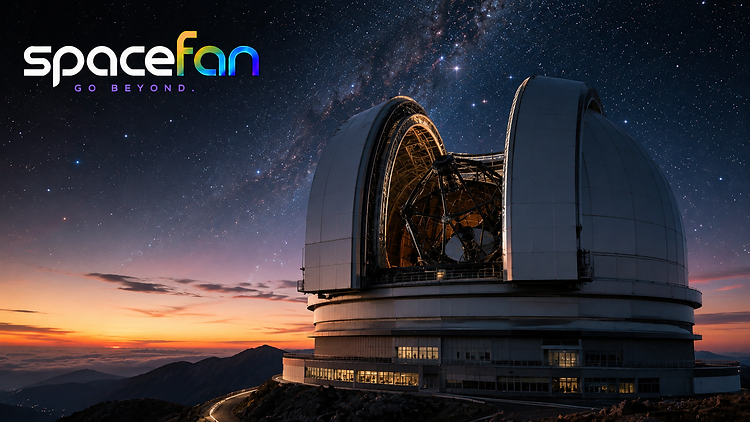
Large astronomical telescope inside an open mountain observatory dome beneath a star-filled night sky.
Image · Space.Fan

The Drop

For years, space experts have used a model called Lambda-CDM to explain how the universe works. This model assumes dark energy, a mysterious force pushing the universe to expand, stays exactly the same all the time. However, some recent studies suggest dark energy might actually change, which would mean our current map of the cosmos is incomplete. To solve this, researchers have designed a new plan that combines the power of two major tools: the Vera C. Rubin Observatory and the Dark Energy Spectroscopic Instrument, also known as DESI. The Vera C. Rubin Observatory is like a giant camera that can spot exploding s, known as Type Ia e, across the sky. These s are perfect distance markers for measuring how fast the universe expands. Once Rubin finds one, the team will tell DESI where to point. DESI, which is a powerful spectrograph, can then quickly look at the light from those s to confirm exactly what they are and how far away they are. By working together ting in 2027, these two machines could gather enough data in just one year to prove if dark energy is truly shifting.
Advertisement

Why It Matters

If dark energy is changing, it would be a major discovery that breaks our current rules of physics. This would force scientists to change how they think about the past and the future of our universe. By gathering this data, researchers can see if the standard model of the universe holds up or if we need a brand-new theory to explain why the cosmos is growing the way it is.
Advertisement

The Catch

This study is a proposal based on a model rather than a completed experiment. While the plan is very strong, it depends on the ability of the two telescopes to coordinate perfectly without missing their targets. There is also the challenge of 'systematics,' which are small errors that can build up during data collection. While the researchers have created methods to fix these errors, they still need to prove it works in the real world once the observations begin.

Put That in Perspective

Scientists have been measuring the expansion of the universe for decades using exploding stars as a standard 'ruler.' This new project is special because it does not rely on old ways of reading star brightness. Instead, it uses advanced computer programs to learn the secrets of these stars directly from their light spectra, which should make the final results much more accurate than anything we have done before.

Source September 30, 2026
ApJ

Keep Exploring Space