Space.Fan — Go Beyond
ApJS · 40 MIN AGO
Sun & Space WeatherPEER REVIEWED

AI Helps Scientists Predict Powerful Solar Storms Before They Happen

By Space.Fan Editorial Desk

Researchers used a new computer program to find clues on the Sun that show when a massive solar storm is about to blast toward Earth.
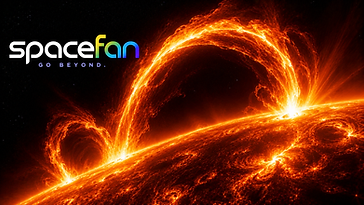
A bright solar flare erupting from the surface of the Sun.
Image · Space.Fan

The Drop

The Sun is home to massive explosions called solar flares and coronal mass ejections (CMEs). These events send giant clouds of super-hot gas and magnetic energy flying through space. When these clouds are pointed directly at Earth, they can disrupt satellites, radio signals, and our power grids. Some of these eruptions appear as a full circle around the Sun, which scientists call a halo, and these are often the most dangerous for our . Predicting exactly when these halo events will occur has been a difficult challenge for space experts for a long time. Now, a team of scientists has used a special type of machine learning, which is a kind of smart computer program, to look at solar data. They trained this program to examine the magnetic environment on the surface of the Sun leading up to these big explosions. The researchers used information gathered by the Solar Dynamics Observatory to spot patterns in the Sun's magnetic fields. By looking at data from up to 24 hours before a big eruption, the computer program learned how to identify which active regions on the Sun were likely to produce a halo-shaped cloud. The program looked at how the magnetic field twisted and changed over time, acting like a warning system for incoming space weather.

Why It Matters

This research is important because it gives us a better way to prepare for solar storms. By identifying the specific magnetic 'fingerprints' that lead to large halo eruptions, scientists can get a better head t on tracking the movement of space weather. This helps protect the technology we rely on every day, such as GPS, airplanes, and the internet, by giving engineers more time to prepare for potential interference.

Aurora Tonight

Live NOAA outlook

Low aurora activity

Mostly Arctic: Alaska, northern Canada, Greenland, and far-northern Europe

Aurora activity22%
Peak Kp tonight: 2.3NOAA nowcast max: 12%Source: NOAA SWPC

Aurora forecasts are probabilistic. Darkness, clouds, local light pollution, and rapidly changing solar-wind conditions affect what you can actually see.

The Catch

While the new computer program is very good at spotting these patterns, it is not perfect. The researchers noted that they had to use special methods to balance the data, because these giant halo events do not happen as often as smaller solar activities. Because the results come from a computer model, it is still a tool to help human experts make decisions rather than a guarantee of what the Sun will do next.

Put That in Perspective

Scientists have spent years studying the Sun's magnetic field, but this study shows how new computer tools can find connections in massive amounts of data that would take humans much longer to process. Future research will likely focus on making these AI tools even faster so they can provide real-time updates for space weather forecasting.

Source November 22, 2026
Abd-ur Raheem, Huseyin Cavus, Jason T. L. Wang, Gani Caglar Coban, Haimin Wang
Canakkale Onsekiz Mart University, New Jersey Institute of Technology·The Astrophysical Journal Supplement Series·10.3847/1538-4365/aeb2ff

Keep Exploring Space