Space.Fan — Go Beyond
ApJL · 13 HR AGO
Sun & Space WeatherSIMULATION

Better Computer Models Reveal Secrets of Solar Storms

By Space.Fan Editorial Desk

Scientists found that tracking energy exactly in computer models is key to predicting how powerful a solar eruption will be.
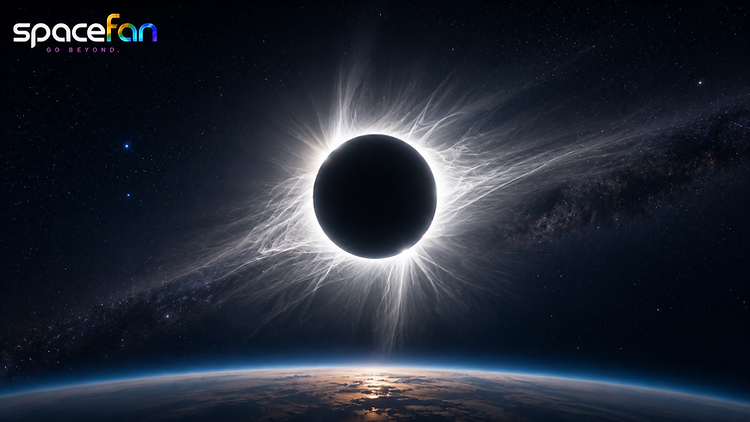
Total solar eclipse with a brilliant white corona suspended above the curved horizon of Earth viewed from space.
Image · Space.Fan

The Drop

Our Sun is a giant, churning ball of hot gas that sometimes lets off huge explosions called solar eruptions. These events can send billions of tons of matter into space, which we call coronal mass ejections. To predict if these storms will hit Earth, scientists use powerful computer programs to mimic what is happening on the Sun. However, these programs have always struggled to perfectly balance the energy involved in the explosion. A team of researchers used a specialized computer model known as the Alfvén Wave Solar atmosphere Model to study these events. They ran two versions of the same solar explosion. In one version, the model followed strict rules to keep energy perfectly balanced. In the other version, it did not. This helped them see exactly how energy changes affect the way a storm behaves. The results were surprising. The model that kept the energy balanced showed a solar eruption that was twice as strong as the one that did not. It turns out that heat and motion are linked in ways that simple computer models often miss. By tracking energy correctly, the scientists were able to see that heat actually changes the speed and power of the eruption as it moves away from the Sun.

Why It Matters

This study is a big deal for space weather forecasting. When we know the exact energy budget of a solar storm, we can better predict how hard it might hit our . Since these storms can affect satellites and power grids, having an accurate model helps us prepare for space weather in a more reliable way.

Aurora Tonight

Live NOAA outlook

Low aurora activity

Mostly Arctic: Alaska, northern Canada, Greenland, and far-northern Europe

Aurora activity20%
Peak Kp tonight: 2NOAA nowcast max: 15%Source: NOAA SWPC

Aurora forecasts are probabilistic. Darkness, clouds, local light pollution, and rapidly changing solar-wind conditions affect what you can actually see.

The Catch

This study is based on a computer simulation of a simple, idealized magnetic field on the Sun. The real Sun is much more chaotic and complex than what a model can represent right now. While these results show that energy balance is important, they are not a perfect replica of every real-world solar storm.

Put That in Perspective

Scientists have known for a long time that energy must be conserved in physics, but applying this to massive solar storms is a new challenge. The next step for the team is to use these better modeling techniques to simulate more complicated and realistic solar events to see if the results hold true.

Source November 22, 2026
Xianyu Liu, Spiro K. Antiochos, Nishtha Sachdeva, Gábor Tóth, Ward B. Manchester IV, Bart van der Holst, Igor V. Sokolov, Tamas I. Gombosi, Lulu Zhao
University of Michigan, Boston University·The Astrophysical Journal Letters·10.3847/2041-8213/aebdff

Keep Exploring Space