Advertisement
Space.Fan — Go Beyond
arXiv · 8 DAYS AGO
UniverseEARLY RESEARCH

Are Giant Black Holes Spinning Inside Cosmic Disks?

By Space.Fan Editorial Desk

Scientists are using new math to figure out if black hole mergers are happening inside the swirling centers of distant galaxies.
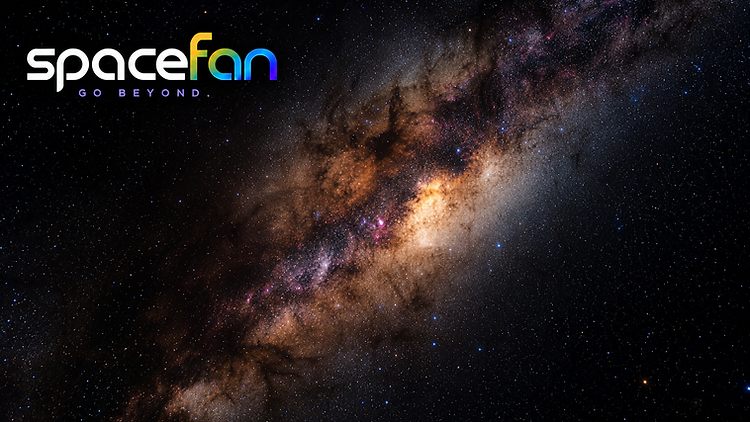
Dense star fields and glowing dust clouds across the center of the Milky Way galaxy.
Image · Space.Fan

The Drop

When two s crash into each other, they send out ripples in space called gravitational waves. Scientists have spotted many of these crashes using observatories like LIGO, Virgo, and KAGRA. However, researchers are still trying to figure out exactly where these s come from before they merge. One popular idea is that they live in the swirling, super-hot rings of gas found at the centers of galaxies, known as active galactic nuclei, or AGNs. To test this, a team of researchers built a new computer model. They combined data from gravitational wave detectors with maps of bright galaxies from the Quaia catalog. This allows them to see if the places where s merge happen near known galactic centers more often than we would expect by chance. So far, the results show that it is possible for s to be hanging out in these galactic disks. While the team could not say for sure that this is happening, they were able to set limits on how many mergers could be coming from these active galaxy centers. This new math tool acts like a filter to help scientists better organize the data we get from space. This work is important because it changes how we look for origins. By using both gravitational waves and light-based telescope data together, researchers can get a much clearer picture of what is happening deep in the cosmos. It moves us away from guessing and toward using strict math to explain the populations of s we see.
Advertisement

Why It Matters

Understanding where s form helps us learn how galaxies grow and change over time. If many s are merging inside galactic disks, it would explain why some s grow so quickly and spin so fast. This study provides a new way to test these ideas using existing technology.
Advertisement

The Catch

This study does not prove that s definitely live in these disks. It only sets boundaries on how many could be there based on what we have seen so far. Because space is huge and our current detectors only catch some events, there is still plenty of room for other explanations or missed data.

Put That in Perspective

Scientists are moving toward a more complete view of the universe by combining different types of data. Future research will likely focus on gathering more gravitational wave detections to refine these numbers and see if the connection to galaxy centers becomes clearer.

Source September 17, 2026
Lucas Pouw, Lorenzo Speri, Niccolò Veronesi, Elena Maria Rossi
·10.48550/arXiv.2609.17665

Keep Exploring Space