Advertisement
Space.Fan — Go Beyond
ApJ · 2 HR AGO
DiscoveriesPEER REVIEWED

New AI Tool Speeds Up Exoplanet Atmosphere Research

By Space.Fan Editorial Desk

Scientists have created a new computer tool that helps us study distant planet atmospheres faster than ever before.
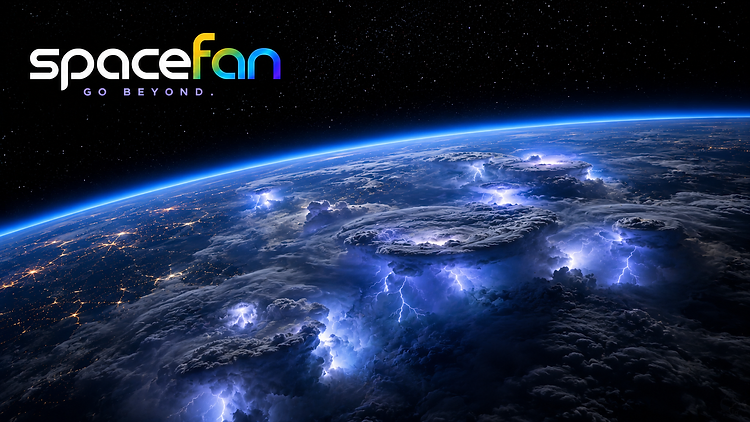
Massive thunderstorms flashing with lightning across Earth's cloud-covered atmosphere as seen from space.
Image · Space.Fan

The Drop

To understand what it is like on s orbiting other s, scientists build complex computer models. These models show how gases move and change inside an atmosphere. In the past, these simulations were so complicated that they took a very long time to run. Researchers often had to simplify their math, which meant their results were not always perfectly accurate. Now, a team of researchers has developed a new way to speed up this process using machine learning. They created a special kind of computer program that acts like a shortcut for these difficult math problems. Instead of calculating every single step from scratch, the program learns to predict the results based on what it knows about how gases behave. This new tool is incredibly fast, working thousands of times quicker than the old methods. It can provide accurate results in just a blink of an eye. The team tested it on a wide range of conditions, covering many different types of temperatures and gas mixtures, and found that it stays very reliable and precise. By using this new software, scientists can now simulate how atmospheres work without waiting weeks or months for a computer to finish its work. It allows them to explore many more possibilities, helping them get a better picture of what these faraway worlds might actually look like.
Advertisement

Why It Matters

This breakthrough changes how we look for chemical signatures in the air of distant s. By making these simulations so much faster, researchers can now compare their models to real-world telescope data much more easily. It helps rule out wrong guesses about a 's climate and lets experts focus on the most likely scenarios.
Advertisement

The Catch

While this tool is very fast and accurate, it is still a computer model and not a direct observation of a . It relies on the data it was trained on, so it may not perfectly represent extreme conditions that were not included in its training set. Researchers must still be careful to check their results against actual physical measurements from telescopes.

Put That in Perspective

In the past, studying exoplanet chemistry was like trying to draw a detailed map by hand while someone kept erasing your work. This new technology acts like a digital printer, allowing us to generate these maps almost instantly. Next, researchers plan to use this tool to better understand complex planetary weather patterns that were previously too difficult to model.

Source September 24, 2026
Isaac Malsky, Xi Zhang, Tiffany Kataria, Matthew Graham, Ziyu Huang, Boris Bonev, Shang-Min Tsai, Elspeth K. H. Lee
Jet Propulsion Laboratory, California Institute of Technology, University of California Santa Cruz, Georgia Institute of Technology, NVIDIA Corporation, University of California Riverside, Academia Sinica, University of Bern·The Astrophysical Journal·10.3847/1538-4357/aea15b

Keep Exploring Space