Advertisement
Space.Fan — Go Beyond
ApJ · 2 DAYS AGO
UniversePEER REVIEWED

Astronomers Identify a Rare and Superbright Nova in Our Galaxy

By Space.Fan Editorial Desk

Scientists discovered that one specific star explosion was much brighter than others by studying how its light faded over time.
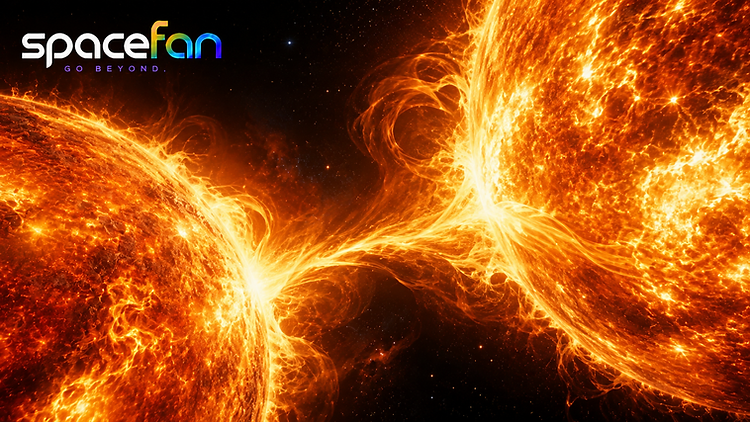
Two fiery stars interacting through huge glowing loops and streams of stellar plasma.
Image · Space.Fan

The Drop

A nova happens when a white dwarf steals material from a neighbor until it explodes in a sudden burst of light. Most novae have a standard brightness, but some are much more powerful. Astronomers call these extra-bright events superbright novae. Recently, researchers looked at six different s to see if they fit this special, powerful group. By studying how the light from these s dimmed over time, the team could tell exactly how the explosions behaved. For one , known as V838 Her, the light patterns showed it was truly a superbright nova. The team believes this happens because a fast-moving shell of gas gets pushed out by a shockwave, creating a massive, glowing wall of material far away from the . The study used mathematical models to compare the light from these s against known patterns of wind. While V838 Her stood out, the other five s in the group did not match the pattern. Their light was explained by simpler gas movements, meaning they are just regular novae, not the rare superbright kind.
Advertisement

Why It Matters

This research helps astronomers sort different types of explosions into the right categories. By knowing which novae are superbright and which are not, scientists can better understand the physics behind how white dwarf s lose material and explode. It confirms that a special mechanism—a fast shockwave hitting a shell of gas—is required to reach the highest levels of brightness.
Advertisement

The Catch

This study relies on computer models to guess what is happening near the s. Because we cannot visit these distant explosions, the results are based on how well the math matches the light we see from Earth. It is possible that other physical processes not included in these specific models could also create similar patterns of light.

Put That in Perspective

Scientists have previously identified only two other stars, V1500 Cyg and V1674 Her, as being this bright. By comparing V838 Her to these famous examples, researchers are slowly building a clearer picture of how rarely these powerful explosions occur in our galaxy.

Source September 22, 2026
Izumi Hachisu and Mariko Kato
The University of Tokyo and Keio University·The Astrophysical Journal·10.3847/1538-4357/ae96a8

Keep Exploring Space