Advertisement
Space.Fan — Go Beyond
ApJ · 3 DAYS AGO
Sun & Space WeatherSIMULATION

Could Small Red Stars Be Better Homes for Planets?

By Space.Fan Editorial Desk

New simulations show that giant magnetic bursts from some stars might be less harmful to nearby planets than we once thought.
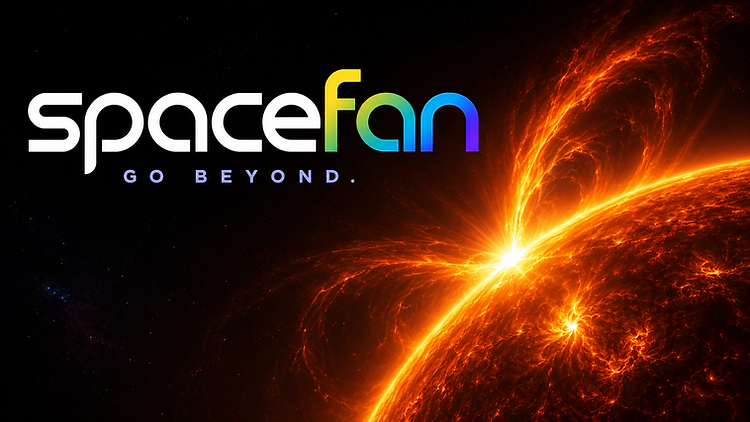
A bright solar flare erupting from the surface of the Sun.
Image · Space.Fan

The Drop

Small, cool s known as M dwarfs are very common in our galaxy. Astronomers search these s for s that could support life. These s are known to be quite moody, often sending out giant clouds of hot gas and magnetic energy called coronal mass ejections, or CMEs. These space storms can strip away a 's air and make the surface too harsh for life. To see if these s are safe, researchers used powerful computer simulations to track how these space storms move. They looked at a special type of M dwarf that has a unique magnetic field, where the magnetism is mostly pushed to one side of the . This creates a lopsided magnetic environment that acts differently than a normal, balanced . Their study found that most of these giant storms from the fly away from the equator where s usually orbit. Because these explosions head toward the 's poles instead of the s, the s are mostly protected from the worst of the weather. When a storm does happen to head toward a , the researchers found that the thick winds around the help to slow it down. This acts like a natural shield, making the storm much weaker by the time it reaches a . The result is a much quieter environment than experts previously guessed, which might be good news for finding life on these worlds.
Advertisement

Why It Matters

This study is important because it changes how we look for life in space. For a long time, scientists worried that M dwarf s were too violent to let s keep their air. If these s have the lopsided magnetic fields described in the study, they could be much safer for life than we assumed. This finding helps rule out the idea that all M dwarf s are automatically hostile. It suggests that the specific shape of a 's magnetic field is a key piece of the puzzle when we try to decide if a distant world could be a good home.

Aurora Tonight

Live NOAA outlook

Fair aurora activity

Best odds in Alaska, northern Canada, and far-northern Europe

Aurora activity47%
Peak Kp tonight: 4.7NOAA nowcast max: 34%Source: NOAA SWPC

Aurora forecasts are probabilistic. Darkness, clouds, local light pollution, and rapidly changing solar-wind conditions affect what you can actually see.

Advertisement

The Catch

The biggest catch is that this study is a computer simulation, not a direct observation of a real . Researchers do not yet have proof that M dwarfs actually have the lopsided magnetic shapes used in the model. If real s have different magnetic setups, the space weather environment could be much more dangerous than the simulation shows.

Put That in Perspective

Earlier studies predicted that space weather around small red stars would be extremely intense and potentially destroy a planet's atmosphere. By showing how specific magnetic shapes can protect planets, this work provides a new, more hopeful way to view these common stars, shifting the focus from general fear to specific magnetic details.

Source September 21, 2026
Zheng Sun, Julián D. Alvarado-Gómez, Hui Tian, Ofer Cohen, Jeremy J. Drake, Katja Poppenhäger, Yue-Hong Chen
Peking University, Chinese Academy of Sciences, Leibniz Institute for Astrophysics Potsdam, University of Massachusetts Lowell, Lockheed Martin Solar and Astrophysics Laboratory, University of Potsdam, Nanjing University·The Astrophysical Journal·10.3847/1538-4357/ae976d

Keep Exploring Space