Space.Fan — Go Beyond
ApJ · 23 HR AGO
Sun & Space WeatherPEER REVIEWED

The Sun's Surface Has a Hidden Magnetic Heartbeat

By Space.Fan Editorial Desk

Scientists have found that the Sun's outer layers change their shape and speed as the solar cycle heats up.
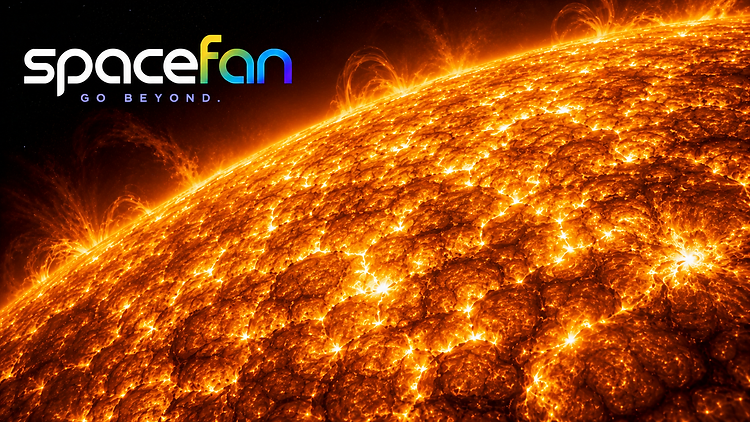
Close-up of the fiery Sun showing bright active regions and looping plasma above its surface.
Image · Space.Fan

The Drop

Our Sun is a giant, spinning ball of hot gas. Deep inside, it moves in ways that create magnetic fields. Scientists have been studying a special thin layer near the surface of the Sun to see how it moves. By looking at data from a tool called the Helioseismic and Magnetic Imager, researchers measured how fast different layers of the Sun spin. They found that the Sun has a layer of 'shear,' which is a fancy way of saying that different parts of the gas are rubbing against each other at different speeds. Researchers discovered that this layer of rubbing gas changes shape over time. When the Sun is very active—meaning it has many dark sunspots and high magnetic energy—this layer gets shallower, stronger, and a bit thinner. It is like the Sun is tightening its own belt as it gets more active. To see this, scientists used a technique called ring-diagram measurements. Think of it like using an ultrasound on a person to see inside the body. By looking at how sound waves move inside the Sun, they can map out the flows of gas that we cannot see with our eyes. This helps them understand how the Sun's magnetic field, which causes solar storms, is connected to the movement of gas at the surface.
Advertisement

Why It Matters

This discovery helps us understand the hidden engine inside the Sun. By seeing how magnetic fields and gas flows are linked, scientists can better predict when the Sun might have a big magnetic outburst. Knowing how the shear layer changes tells us that the Sun's magnetism is not just happening deep down, but is also shaped by what happens near the surface. This helps improve our models of how the solar cycle works, which is important for keeping our satellites and power grids safe from space weather.

Aurora Tonight

Live NOAA outlook

Fair aurora activity

Best odds in Alaska, northern Canada, and far-northern Europe

Aurora activity43%
Peak Kp tonight: 4.7NOAA nowcast max: 22%Source: NOAA SWPC

Aurora forecasts are probabilistic. Darkness, clouds, local light pollution, and rapidly changing solar-wind conditions affect what you can actually see.

Advertisement

The Catch

This study focuses on a very specific thin slice of the Sun. While the results are clear, small errors in how the instruments are calibrated can make it hard to tell if a change is real or just a measurement glitch. The researchers noted that they have to be very careful to account for these tiny errors to make sure their findings are accurate.

Put That in Perspective

In the past, scientists mainly looked at the whole Sun at once. Now, with better tools, they can look at tiny, specific depths. This study confirms that the Sun acts as a complex system where the outer skin is just as important as the deep interior. Future work will likely look at how these flows change over many years to confirm these patterns repeat every solar cycle.

Source September 23, 2026
ApJ

Keep Exploring Space