Advertisement
Space.Fan — Go Beyond
ApJ · 19 HR AGO
Sun & Space WeatherPEER REVIEWED

How Turbulence Calms Down in the Space Near Earth

By Space.Fan Editorial Desk

Scientists used NASA's MMS mission to discover how chaotic energy in space settles down after crashing into Earth's magnetic shield.
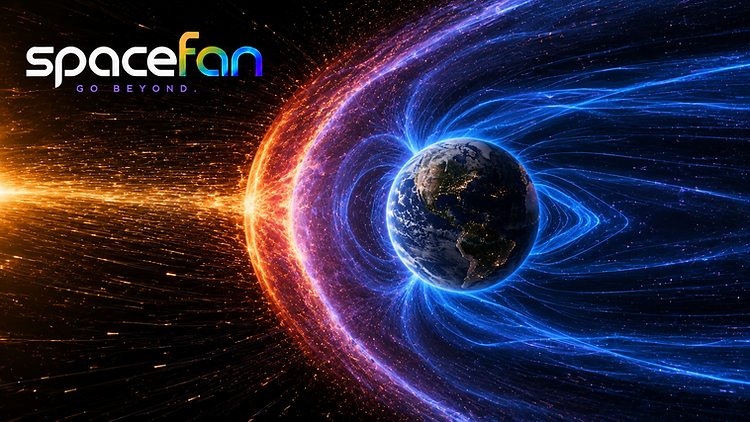
Earth surrounded by glowing magnetic field lines as solar particles strike the magnetosphere.
Image · Space.Fan

The Drop

Space is not just empty silence. It is filled with hot, flowing gases called plasma. As plasma from the Sun travels toward Earth, it hits a protective barrier called the bow shock. This collision creates a messy, swirling region called the magnetosheath. Think of it like water swirling behind a rock in a fast-moving stream. Scientists wanted to know what happens to this swirling energy once it moves past the bow shock. They used data from the Magnetospheric Multiscale (MMS) mission, which acts like a group of specialized sensors flying through space. By looking at information from 15 different trips through this region, they tracked how the energy changes. They found that the energy levels jump up massively—hundreds of times higher—right when the plasma crosses the shock. However, as the plasma keeps moving further away from that initial collision, the swirling motion slowly ts to fade. It behaves in a very predictable pattern, similar to how energy levels change in the solar wind much farther out in space. This study shows that the way the energy is first pushed into the system helps decide how fast the turbulence dies out. Even though this region is small compared to the vastness of the Sun's reach, it follows the same basic rules of physics.
Advertisement

Why It Matters

Understanding this energy decay is important because it tells us how our interacts with the Sun's activity. The magnetosheath is the first place that solar plasma hits before it touches Earth's magnetic field. By learning how turbulence works here, scientists can better predict how energy from the Sun reaches our . This helps us understand how space weather might affect things like satellites or communication systems that we rely on every day.
Advertisement

The Catch

The study focuses on 15 specific times the satellites crossed into the magnetosheath. While these results are clear, the researchers noted that the speed at which the turbulence fades can change depending on the type of solar wind hitting the area. Because the solar wind is constantly changing, these patterns might look slightly different during more intense solar storms.

Put That in Perspective

Scientists have studied turbulence in the solar wind for a long time, but studying it in the compact area of the magnetosheath is a newer challenge. This research shows that even in these smaller, complex zones near Earth, the laws of space physics remain consistent with what we see in the wider solar system.

Source September 30, 2026
Victor Montagud-Camps, Petr Hellinger, Sergio Toledo-Redondo, Andrea Verdini, Luca Sorriso-Valvo, Francesco Pecora, Julia E. Stawarz, Alexandros Chasapis, Emanuele Papini, Inmaculada F. Albert, Aida Castilla
University of Murcia, Universitat de les Illes Balears, Astronomical Institute of the Czech Republic, INAF—Osservatorio Astrofísico di Arcetri, University of Florence, Istituto per la Scienza e Tecnologia dei Plasmi, CNR, KTH Royal Institute of Technology, University of Delaware, Northumbria University, Laboratory for Atmospheric and Space Physics, Instituto di Astrofísica e Planetologia Spaziali·The Astrophysical Journal·10.3847/1538-4357/ae9ebc

Keep Exploring Space