Advertisement
Space.Fan — Go Beyond
ApJ · 31 MIN AGO
UniverseSIMULATION

How Two Dying Stars Can Cause a Massive Space Explosion

By Space.Fan Editorial Desk

New computer simulations show how a crash between two stars leads to a brilliant supernova explosion.
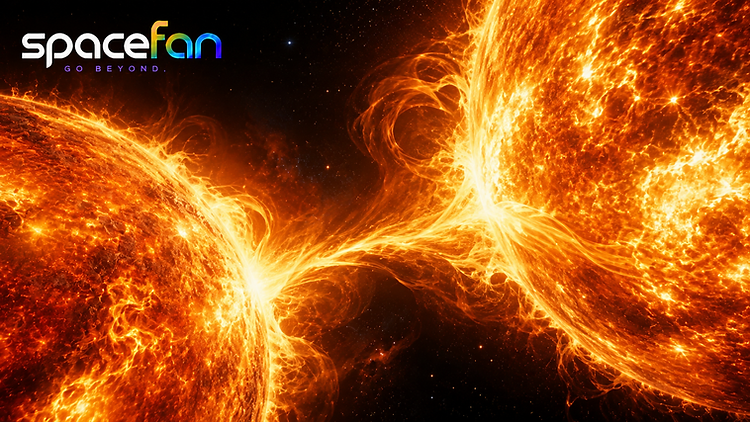
Two fiery stars interacting through huge glowing loops and streams of stellar plasma.

The Drop

When s reach the end of their lives, some become white dwarfs. These are small, dense objects left over after a runs out of fuel. Scientists have long wondered how these s sometimes explode in massive events called Type Ia e. One popular idea involves two white dwarfs orbiting each other. As they dance closer, one pulls gas away from the other. This gas forms a stream that slams into the surface of the main . To study this, researchers used powerful computer programs to run simulations of the collision. They wanted to see if the gas stream hitting the was enough to trigger an explosion. By looking at s of different sizes, the team watched how the shock from the impact traveled through the 's layers. The results showed that in almost every case, the impact caused the 's outer shell to ignite. This spark then sent a shockwave deep into the center of the . That shockwave triggered a final, massive blast that blew the entire apart. This helps explain how these binary systems end their lives with a cosmic bang.
Advertisement

Why It Matters

Type Ia e are incredibly important to astronomers because they always shine with a similar brightness. This makes them like cosmic yardsticks that help us measure how far away galaxies are and how fast the universe is growing. By confirming this model, scientists gain a better understanding of how these important explosions begin.
Advertisement

The Catch

While these simulations are very detailed, they are still just models on a computer. The actual behavior of s in space is incredibly complex, and researchers cannot yet observe these specific moments of impact in real-time. There is also a chance that different conditions in space might lead to different outcomes not yet captured in these tests.

Put That in Perspective

Earlier studies looked at this idea, but this new work is special because it uses a more realistic model of how a white dwarf is built. Future work will likely look at even more complex scenarios to see if other factors change the outcome.

Source November 25, 2026
Nethra Rajavel, Dean M. Townsley, Ken J. Shen
The University of Alabama, University of California, Berkeley·The Astrophysical Journal·10.3847/1538-4357/aeb544

Keep Exploring Space