Advertisement
Space.Fan — Go Beyond
ApJ · 31 MIN AGO
Sun & Space WeatherPEER REVIEWED

A New Way to Predict Dangerous Solar Flares Before They Happen

By Space.Fan Editorial Desk

Scientists found a hidden clue in the Sun's magnetic fields that helps tell the difference between mild solar activity and big, powerful flares.
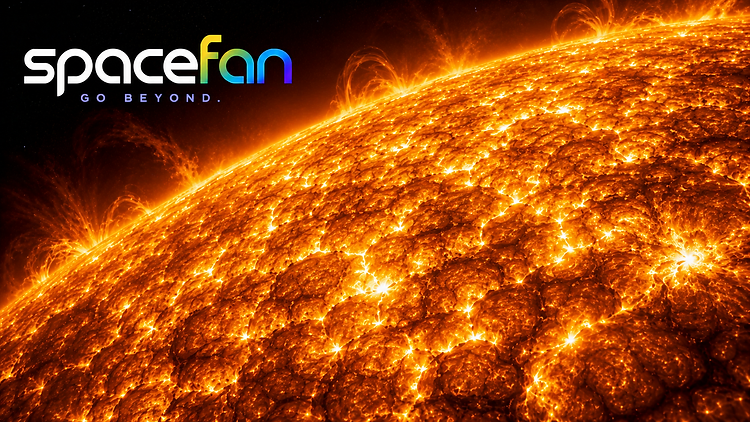
Close-up of the fiery Sun showing bright active regions and looping plasma above its surface.
Image · Space.Fan

The Drop

Our Sun is a giant, glowing ball of gas that can sometimes erupt with huge bursts of energy called solar flares. These flares can disrupt satellites, radio signals, and power grids on Earth. For a long time, scientists have looked for better ways to figure out which areas on the Sun will explode and which ones will stay calm. New research shows that a special feature called a Polarity Inversion Line acts like a warning sign for these big events. A Polarity Inversion Line is a boundary on the surface of the Sun where magnetic forces flip direction. Think of it like a border between two different weather systems. Researchers looked at 40 different active areas on the Sun to see how these lines changed over time. By looking at the length of these lines at different heights—specifically about one to two miles above the Sun's surface—they noticed a clear difference between quiet spots and ones about to have a major flare. The team used complex computer math to map out these magnetic fields before a flare happened. They found that in areas that produce strong flares, these boundary lines grow much longer than in areas that stay quiet or only have tiny puffs of activity. By measuring the length of these lines at specific heights, researchers could correctly pick out the dangerous regions with high accuracy.
Advertisement

Why It Matters

This discovery matters because it could give us a head t in predicting space weather. If we can spot the patterns that lead to a major solar flare, we can better protect our technology here on Earth. Knowing which regions are most likely to explode helps space agencies and power companies prepare for potential disruptions. This research highlights that looking at the magnetic fields in the lower atmosphere of the Sun is key to understanding how these massive storms begin.
Advertisement

The Catch

While these results are very promising, they are based on a study of 40 active regions. Scientists still need to test this method on many more examples from the Sun to see if it works every time. Because the Sun is constantly changing, it is possible that some flares develop in ways that this specific measurement might not catch. This is a big step forward, but it is not a perfect crystal ball yet.

Put That in Perspective

Scientists have studied solar flares for decades, but new technology now lets us look at the Sun's magnetic fields in 3D rather than just a flat image. Researchers will likely use this method to help build faster computer models that can watch the Sun and warn us of incoming solar storms in real-time.

Source November 25, 2026
Shreeyesh Biswal, Marianna B. Korsós, Manolis K. Georgoulis, Alexander Nindos, Spiros Patsourakos, and Robertus Erdélyi
University of Sheffield, University of Ioannina, Johns Hopkins University Applied Physics Laboratory, Eötvös Loránd University, Hungarian Solar Physics Foundation·The Astrophysical Journal·10.3847/1538-4357/aeb930

Keep Exploring Space