Advertisement
Space.Fan — Go Beyond
ApJ · 1 HR AGO
UniversePEER REVIEWED

James Webb Telescope Reveals Secrets of Cosmic Dust in Distant Galaxies

By Space.Fan Editorial Desk

Scientists have used a powerful space telescope to track special dust molecules that help galaxies grow and change.
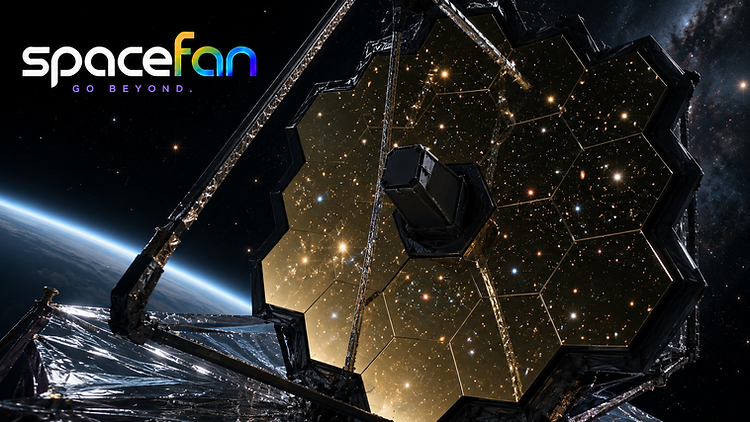
James Webb Space Telescope in space with its gold segmented mirror facing the stars.

The Drop

Astronomers recently used the James Webb Space Telescope to look at 224 different galaxies located far away in space. They were searching for tiny particles called polycyclic aromatic hydrocarbons, or PAHs for short. These particles are essentially space dust, but they act like a signature that shows if a galaxy is busy making new s. By using the telescope's MIRI instrument, the team could spot the specific light these molecules give off even from across the cosmos. This helped them figure out how much dust was in each galaxy. The study found that galaxies seem to flip from having very little of this dust to having a lot of it quite quickly as they mature. This happens once a galaxy has reached about 70 percent of the amount of heavy elements found in our own Sun. The researchers also noticed that big, bright galaxies that are actively forming s have more of these special dust grains than galaxies that have stopped making new s.
Advertisement

Why It Matters

This study is important because it tells us about the life cycle of galaxies. It helps scientists understand how galaxies grow, age, and eventually stop creating s. When a galaxy runs out of these dust particles, it often means the galaxy is changing from a busy factory into a quieter place. By learning how these dust grains survive or disappear, researchers can build better maps of how the universe has evolved over billions of years.
Advertisement

The Catch

While these findings are exciting, the study only looked at a specific group of galaxies at a certain distance from Earth. Galaxies that are much further away or much closer might follow different rules. Additionally, the team notes that these dust particles can be destroyed by strong radiation in the galaxy, so the presence of dust is not just a sign of birth but also a balance between the creation and destruction of these tiny molecules.

Put That in Perspective

Scientists have been studying galactic dust for years using older telescopes like Hubble and Herschel, but the James Webb Space Telescope allows them to see details that were previously hidden. Future studies will likely look at even younger, more distant galaxies to see if this dust transition happens the same way during the earliest stages of the universe.

Source November 26, 2026
Chayan Mondal, Chian-Chou Chen, Kanak Saha, Thomas S.-Y. Lai, Irene Shivaei, Hiddo S. B. Algera, Bovornpratch Vijarnwannaluk
S. N. Bose National Centre for Basic Sciences, Academia Sinica Institute of Astronomy and Astrophysics, East Asian Observatory, Inter-University Centre for Astronomy and Astrophysics, IPAC, Centro de Astrobiología·The Astrophysical Journal·10.3847/1538-4357/aeb4b8

Keep Exploring Space