Advertisement
Space.Fan — Go Beyond
PSJ · 8 HR AGO
Solar SystemPEER REVIEWED

Moon Craters Aren't Filled with Ice as Scientists Once Thought

By Space.Fan Editorial Desk

New research shows that the shape of lunar craters is shaped by geology, not hidden pools of water ice.
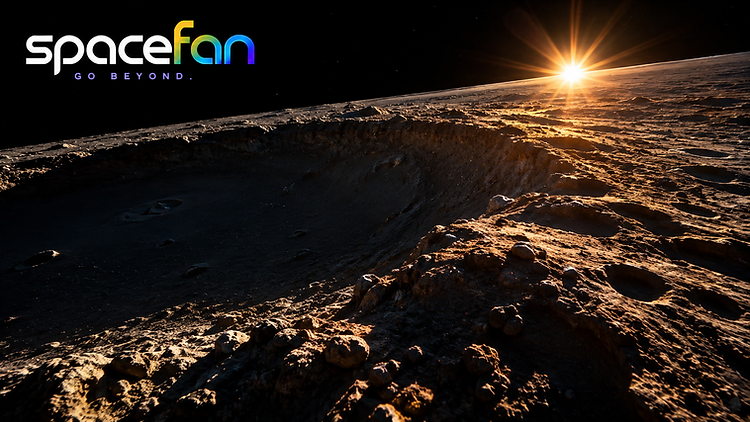
A lunar crater on the surface of the Moon.
Image · Space.Fan

The Drop

For a long time, scientists noticed that craters near the 's south pole looked shallower than those elsewhere. Many experts guessed that this was because large amounts of water ice had collected inside these holes over millions of years, filling them up like a slushy. They expected to see the same thing at the 's north pole, but they didn't find the same patterns there. To figure out what was really happening, a team of researchers looked closely at the shapes of craters at both poles. They measured the depth and width of thousands of impact sites. By comparing these measurements to craters in areas without ice, they were able to see if ice was truly changing the crater depth. Surprisingly, the team found that the ice hiding in the shadows of the is not thick enough to change how a crater looks. Even in places where we know there is ice, the craters didn't show the expected signs of being filled in. Instead, the team discovered that other large-scale geological forces are responsible for making the craters look different at the poles. This means that the shape of a crater is not a reliable map for finding thick ice deposits. Scientists will now have to look for other ways to spot where water might be hiding on the lunar surface.
Advertisement

Why It Matters

This discovery is a major update to how we explore the . For years, astronomers used the shape of craters as a shortcut to search for water ice, which is a vital resource for future human missions. Knowing that crater depth is not a good indicator of ice means we cannot rely on that method alone to find water. Instead, this forces space agencies to use more direct tools to scan for water. It shifts our understanding of the lunar surface from one dominated by simple ice-filling to a more complex story involving ancient geological activity.
Advertisement

The Catch

The study suggests that ice is not thick enough to change crater shapes, but it does not rule out the existence of thinner layers of ice. The researchers point out that their findings depend on the data in their specific crater catalog. Future missions with better sensors might still find evidence of ice that is too subtle to see through crater shape analysis alone.

Put That in Perspective

Scientists have long used crater measurements to guess what is hidden under the moon's soil. This new work highlights that even simple space features can be more complicated than they seem. Future lunar missions will likely need to combine multiple types of data, such as radar and temperature mapping, to get a clear picture of where water might be.

Source September 27, 2026
Sachana Sathyan, Megha Bhatt, Alexander T. Basilevsky, Neeraj Srivastava, K. S. Sajinkumar, Anil Bhardwaj
Physical Research Laboratory, University of Kerala, Vernadsky Institute of Geochemistry and Analytical Chemistry·The Planetary Science Journal·10.3847/PSJ/aea15c

Keep Exploring Space