Advertisement
Space.Fan — Go Beyond
ApJ · 2 HR AGO
Solar SystemNEW OBSERVATION

Juno Spacecraft Reveals How Jupiter Shapes Its Hidden Magnetic Energy

By Space.Fan Editorial Desk

A sudden burst of electrons around Jupiter is changing how the giant planet creates special radio waves in its magnetic neighborhood.
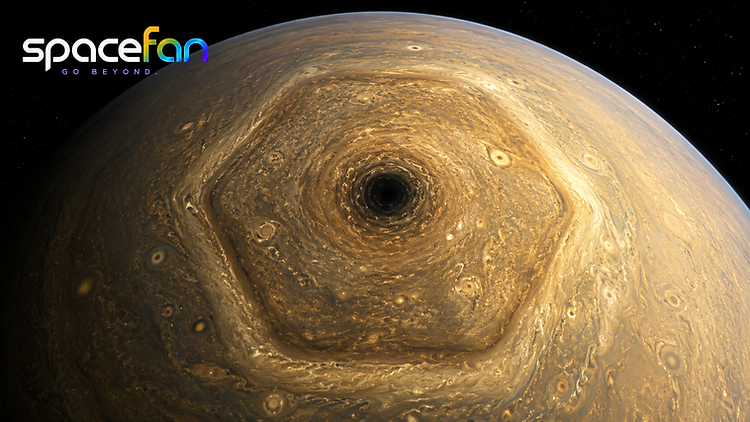
Large dark atmospheric vortex surrounded by swirling storms in Jupiter's turbulent clouds.
Image · Space.Fan

The Drop

Jupiter is a giant world with an invisible magnetic shield that acts like a powerful trap for charged particles. Recently, the NASA Juno spacecraft watched a quick event where a wave of extra electrons flooded into this magnetic trap. This burst lasted for about 30 minutes, acting like a sudden jolt of electricity hitting the area near Jupiter’s equator. Scientists have been studying this region to understand how these particles move and get trapped in the ’s magnetic bubble. By looking at data from Juno, researchers tracked how these electrons interact with invisible, wobbling energy known as whistler-mode waves. These waves act like a highway that helps speed up electrons. When the surge of new electrons arrived, the existing low-frequency waves seemed to disappear, while new types of waves popped up at higher frequencies. Using math and physics rules to study the data, the team found that the incoming electrons changed the balance of the whole system. These electrons helped create new waves at high speeds while pushing down the waves at lower speeds, showing that the magnetic environment is constantly changing based on the particles moving through it.
Advertisement

Why It Matters

This discovery helps us understand how s with strong magnetic fields manage their energy. By seeing how electron bursts change the types of waves present, scientists can better predict how radiation belts work around big s. This is important because these radiation belts can be dangerous for satellites and spacecraft that pass through them.
Advertisement

The Catch

This study focuses on one specific event observed by Juno. While the math explains why the waves changed during this short window, researchers do not know if this is exactly how it always happens during every electron surge. The team used a simplified model to explain the waves, so there might be more complex things happening that the current model does not fully capture.

Put That in Perspective

Scientists have studied these magnetic waves for years, but catching them in the act of changing during an electron surge is rare. Future research will likely focus on looking for more of these events to see if there is a pattern that happens every time Jupiter gets a new boost of energy.

Source September 25, 2026
ApJ

Keep Exploring Space