Advertisement
Space.Fan — Go Beyond
ApJ · 21 HR AGO
DiscoveriesPEER REVIEWED

New AI Tool Clears the Noise from Space Photos

By Space.Fan Editorial Desk

A smart new computer program helps scientists find hidden star nurseries by separating clear signals from fuzzy space static.
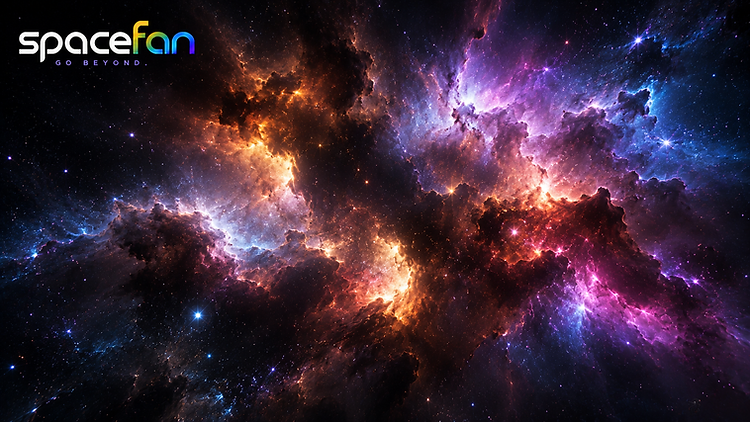
Colorful glowing nebula filled with stars and clouds of blue, purple, orange, and red gas.
Image · Space.Fan

The Drop

Radio telescopes are powerful tools that let us see clouds of gas where s are born. However, the data these telescopes collect can be incredibly messy. It often looks like a collection of noisy, fuzzy pictures. This makes it very hard for astronomers to pick out the important details about how s form. A team of researchers has created a new computer program to solve this problem. They named this system MPEC. It uses a type of artificial intelligence that can learn how to group similar pieces of data together on its own. Instead of having a human manually clean up every photo, the program organizes the data into 'prototypes' and picks out the most important signals. The researchers tested this tool on data collected from the Green Bank Ammonia Survey. They looked at several busy regions where s are currently being born, including the famous Orion Nebula. The program successfully identified very faint signals that had previously been hidden by background static. One of the best features of this system is that it is self-aware. When it finds noise that does not belong to any important -forming gas, it simply throws that noise away. This gives astronomers a much clearer view of the -making process without needing to guess which parts of the data are important.
Advertisement

Why It Matters

This new method is a big deal because it removes human bias from the analysis. In the past, scientists had to pick specific settings for their software, which might accidentally hide or change important information. By letting the machine make these choices, the results are more accurate and reliable. Because this tool is so good at finding faint signals, it allows astronomers to study smaller and more distant -forming regions than before. It effectively turns 'trash' data into 'treasure' by finding meaningful information that was previously thought to be just meaningless static.
Advertisement

The Catch

The tool works very well, but it still relies on the quality of the raw data captured by telescopes. If the original radio telescope data is too poor or lacks enough detail, even the smartest AI cannot create information that is not there. The researchers also focused their study on specific types of gas emissions, so it may need further adjustments to work perfectly for other types of space signals.

Put That in Perspective

Astronomers have struggled with 'noisy' data for decades as telescopes have become more sensitive. Previously, they relied on older statistical methods like spectral clustering, which were much slower and less efficient. Researchers plan to use this tool to map out more star-forming regions in even greater detail.

Source September 21, 2026
Josh Taylor, Stella S. R. Offner, Rachel K. Friesen, Jaime E. Pineda
The University of Texas at Austin, University of Toronto, Max Planck Institute for Extraterrestrial Physics·The Astrophysical Journal·10.3847/1538-4357/ae96a1

Keep Exploring Space