
Advertisement
Space.Fan — Go Beyond
ApJ · 5 HR AGO
DiscoveriesSIMULATION

Scientists Model the Glowing Spiral Arms of a Sweltering Exoplanet

By Space.Fan Editorial Desk

New simulations show how an ultrahot planet loses its atmosphere in a beautiful, giant spiral shape.
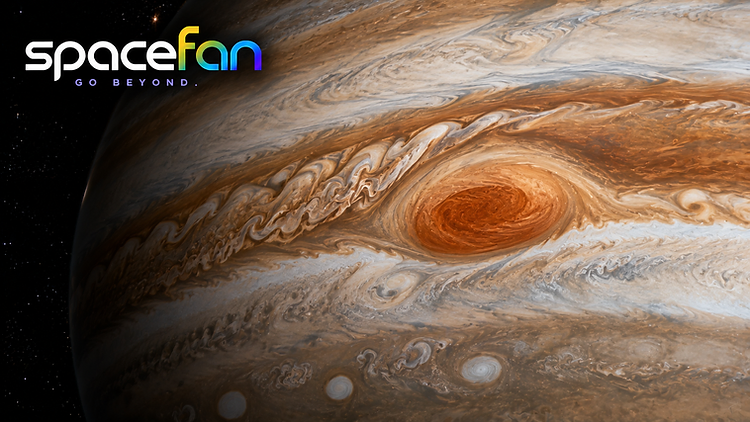
Jupiter's Great Red Spot storm visible from space.
Image · Space.Fan

The Drop

Astronomers have created a new computer model to study a called WASP-121b. This is an ultrahot Jupiter, which means it is a massive gas giant that orbits very close to its . Because it is so hot, the is actually puffing out gas from its own atmosphere into space. To understand what is happening, researchers used a powerful computer framework called Kratos. This tool acts like a giant physics laboratory inside a computer. They combined the laws of physics that govern how gas moves with the way light interacts with chemicals. This let them create a 3D map of how the 's atmosphere behaves from the surface all the way out to the space around it. The results show that the 's escaping gas doesn't just float away in a straight line. Instead, it gets pulled by the 's gravity and the 's own spinning motion. This creates two giant, swirling spiral arms of gas trailing behind the . These arms are made of different types of elements, like iron and sodium, which scientists can detect using telescopes. By comparing their computer model to actual observations of the , the team found that these spiral shapes explain why we see gas moving at such high speeds when we look at WASP-121b. It is a new way to understand how extreme s slowly shrink over time as they lose their air to space.
Advertisement

Why It Matters

This research is a big deal because it helps us decode the light signals we get from distant s. By knowing exactly what those signals mean in terms of gas movement, scientists can better 'see' the invisible processes happening on s s away. It also proves that we don't always need complex theories like high-speed jet streams to explain what we see. Sometimes, the movement of a 's atmosphere is caused by simple gravity and the way the orbits its host , creating these complex spiral patterns.
Advertisement

The Catch

While the computer model is very detailed, it relies on certain guesses about how much light the gives off and exactly what the is made of. Because we cannot visit the to measure its air directly, there is still some uncertainty about how bright the signals from the gas will be in real life.

Put That in Perspective

In the past, astronomers struggled to explain why some gas around these planets appeared to be moving so fast. This new work offers a cleaner explanation that matches what we observe. Researchers hope to use these models with future data from advanced space telescopes to track how other hot planets lose their atmospheres.

Source September 24, 2026
Lile Wang, Yiren Lin, Ji Wang, Fei Dai
Peking University, The Ohio State University, University of Hawaii·The Astrophysical Journal·10.3847/1538-4357/ae986b

Keep Exploring Space