Advertisement
Space.Fan — Go Beyond
ApJ · 4 HR AGO
UniversePEER REVIEWED

New Map of Hydrogen Gas Reveals How the Universe Looked Billions of Years Ago

By Space.Fan Editorial Desk

Astronomers used a powerful Canadian radio telescope to capture a hidden signal from space, mapping the giant clouds of hydrogen that fill our universe.
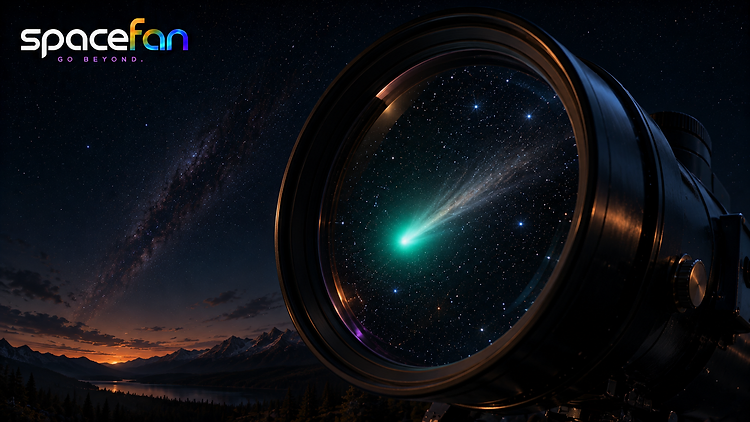
Large telescope lens reflecting a bright green comet beneath the Milky Way above a mountain landscape at dusk.
Image · Space.Fan

The Drop

Scientists have reached an exciting new milestone by listening to the faint glow of hydrogen gas from deep space. Using a massive radio telescope in Canada called the CHIME telescope, the team detected a special signal known as the 21-centimeter signal. This signal acts like a secret message from hydrogen atoms that were spread across the universe about 8 billion years ago. By capturing these radio waves, researchers are getting a better view of how the universe was built. To find this signal, the team looked at data collected over 94 nights. Spotting this signal is incredibly difficult because human-made noise, like radio and TV signals, often gets in the way. The scientists had to create very clever computer programs to filter out this 'static' and focus only on the ancient hydrogen signal coming from the far corners of space. This is the first time the CHIME telescope has successfully measured this signal on its own, without needing to compare it to maps of galaxies made by other telescopes. This proves that the telescope is a very powerful tool that can study the large-scale structure of our universe all by itself.
Advertisement

Why It Matters

Understanding where hydrogen gas is located helps scientists map the 'skeleton' of the universe. Hydrogen is the most common element in existence, and it acts as the raw material for building s and galaxies. By mapping this gas, researchers can learn more about how the universe grew and why it looks the way it does today, providing clues about its history and its mysterious expansion.
Advertisement

The Catch

While this is a great step forward, it is still a complex challenge. The signal detected is extremely faint, and even with advanced filtering, there is a risk that small errors in the data processing could affect the final results. Because this measurement relies on complex computer models, future studies will be needed to confirm these findings and ensure the signals are interpreted correctly.

Put That in Perspective

In the past, scientists relied on mapping individual galaxies to understand the universe. Now, the 21-centimeter signal allows us to look at the 'big picture' of gas distribution directly. Researchers are already planning how to use these results to test new theories about the fundamental nature of space.

Source September 29, 2026
Canadian Hydrogen Intensity Mapping Experiment·ApJ

Keep Exploring Space