Advertisement
Space.Fan — Go Beyond
Universe Today · 15 HR AGO
Solar SystemPEER REVIEWED

Our Solar System Started with Fire Instead of Ice

By Space.Fan Editorial Desk

New research shows that the very first building blocks of our planets were shaped by intense heat rather than frozen space dust.
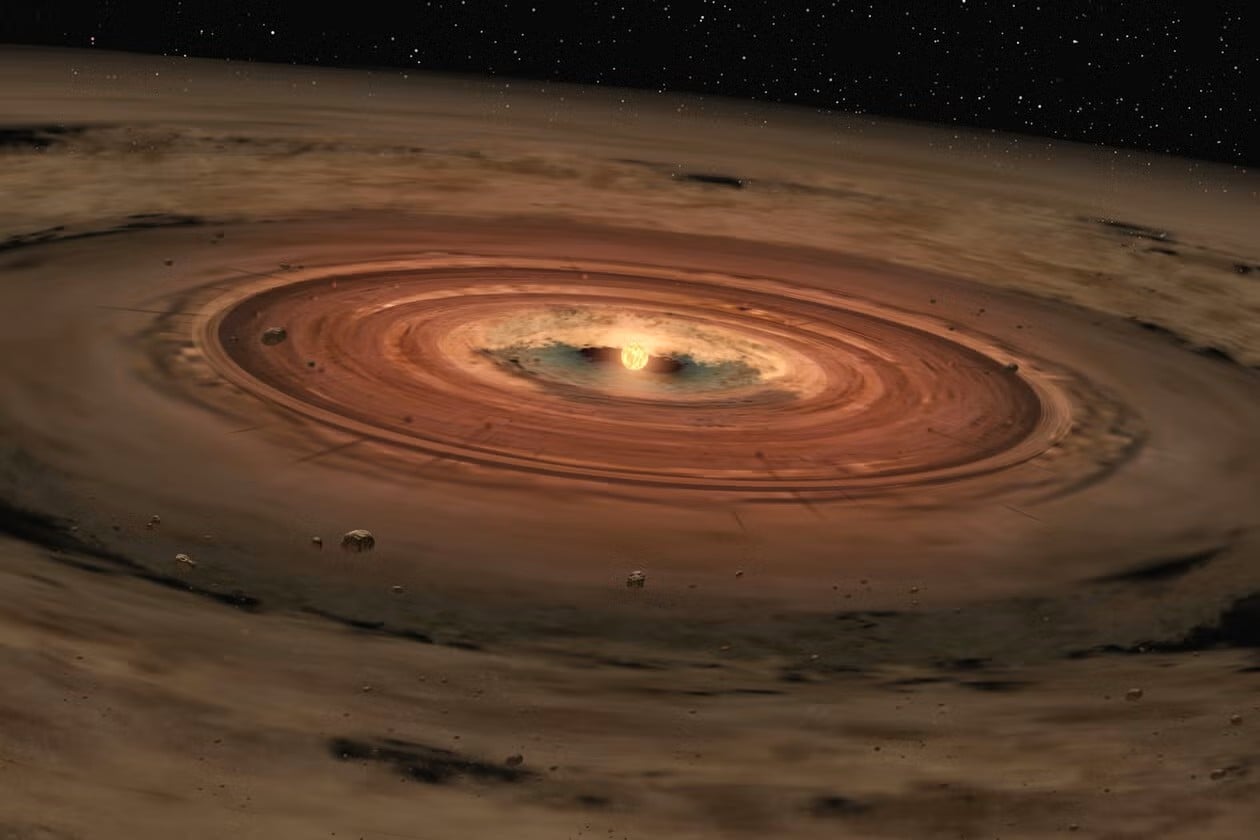
An artist concept showing a young, glowing star surrounded by a swirling disk of dust and hot gas.
Image · Universe Today

The Drop

When our solar system was born, it was like a giant cosmic factory. Scientists have long wondered if the early building blocks were made of frozen ice or if they were scorched by extreme heat. These materials are known as chondrules, which are tiny, rounded pebbles formed by fire-like heat, and matrices, which are fluffy grains filled with icy dust. A new study suggests that fire-formed rocks were much more common than the icy ones during the very first million years of our system. Studying this period is tricky because almost nothing from that time survived in its original form. A radioactive element called Aluminum-26 acted like an internal heater, melting the insides of early s and scrambling their contents. This makes it hard for scientists to tell what the original material looked like just by looking at rocks today. To solve this, researchers studied ancient iron meteorites found here on Earth. These rocks act like time capsules. By measuring the sulfur and the state of the iron inside these meteorites, the team could calculate how much icy material was present when the rocks first formed. They discovered that these meteorites contained very little icy material, meaning the early environment was dominated by fire-forged pebbles rather than ice.
Advertisement

Why It Matters

Understanding the early solar system helps scientists know how s eventually grew. If the early system was mostly hot and filled with these rocky beads, it suggests that the solar system acted like a centrifuge. This natural machine would sort materials by their weight and density, helping rocky s gather the right ingredients to form. This discovery helps us build a more accurate map of how the Sun organized its neighborhood at the very beginning of time.
Advertisement

The Catch

While the results point toward a hot t, this is still a model based on how we think iron meteorites formed. We do not have any physical samples of s from that exact first million years, so scientists have to use math and chemistry to reconstruct what happened. It is possible that our interpretation of how these meteorites were created could change as we find more samples or develop better computer models.

Put That in Perspective

Scientists have known for a long time that chondrules were common between two and four million years after the solar system started. This new research is exciting because it pushes our understanding back even further, to the very first million years. Researchers are now looking at more space rocks to see if this fiery trend holds true across different parts of the early solar system.

Source September 28, 2026
Damanveer Grewal
Yale·Nature Astrophysics

Keep Exploring Space