Advertisement
Space.Fan — Go Beyond
ApJ · 11 HR AGO
UniversePEER REVIEWED

Peering Into the Cosmic Clouds Around Giant Black Holes

By Space.Fan Editorial Desk

Scientists have measured the temperature of the glowing, super-hot clouds of gas surrounding some of the biggest black holes in the distant universe.
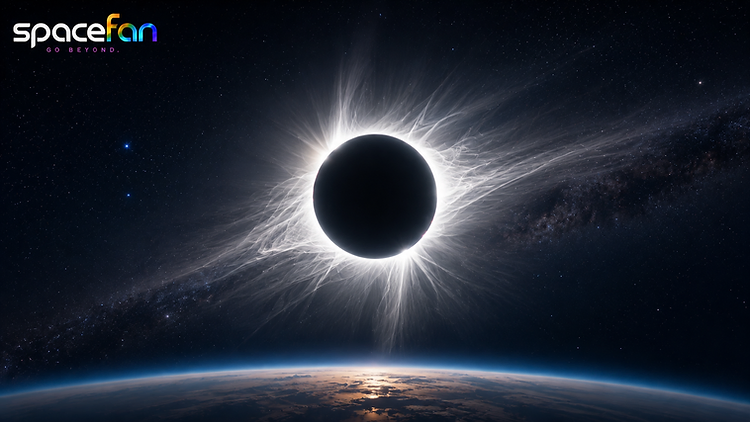
Total solar eclipse with a brilliant white corona suspended above the curved horizon of Earth viewed from space.
Image · Space.Fan

The Drop

At the center of most large galaxies sits a supermassive . As these giants feed, they pull in nearby gas, creating a bright, glowing area called an active galactic nucleus, or AGN. Around these s is a cloud of extremely hot, energetic gas known as a corona. For a long time, it has been hard for astronomers to measure the temperature of these coronas because their main energy signature is hidden from our telescopes on Earth. To solve this, a team of researchers launched the PACHA project. They looked at 13 very distant and bright quasars, which are among the most active s in space. By looking so far away, the expansion of the universe naturally shifts the energy from these coronas into a range that our space telescopes can finally detect. The team used two powerful space telescopes, Nu and XMM-Newton, to look at the same spots at the same time. These instruments allowed them to measure the temperature and density of the hot gas clouds. By catching this light, they could map out the conditions around these monster s for the first time. They found that the coronas around these distant, massive s are cooler than the ones we see around smaller, nearby s. The gas in these distant clouds was also much thicker than expected. This helps show us how the environment around a changes based on its size and how fast it is growing.
Advertisement

Why It Matters

Understanding these gas clouds is key to knowing how s grow and how they affect their home galaxies. If the gas is cooler and thicker, it tells us how the is 'eating' or cooling down as it works. By comparing these distant, giant s to the smaller, closer ones we already know, scientists can better piece together the history of how the universe's most powerful objects evolved over billions of years.
Advertisement

The Catch

While these results are a big step forward, they are based on a small sample of 13 s. Because these objects are so far away, the measurements involve complex math and models to interpret the light signatures. We cannot see the coronas directly, so our understanding depends on these computer models being correct.

Put That in Perspective

In the past, we could only study the black holes in our own neighborhood. Because those coronas are so hot, their energy was often invisible to our telescopes. By using the universe's expansion as a natural magnifying glass, researchers can now compare ancient, distant black holes to modern ones, helping us see if the "rules" for black holes have changed over time.

Source September 28, 2026
ApJ

Keep Exploring Space