Advertisement
Space.Fan — Go Beyond
ApJ · 9 HR AGO
UniversePEER REVIEWED

Scientists Find 'Little Red Dots' Hiding in Our Own Cosmic Neighborhood

By Space.Fan Editorial Desk

Researchers have identified a group of local galaxies that look just like the mysterious 'Little Red Dots' seen in the early universe.
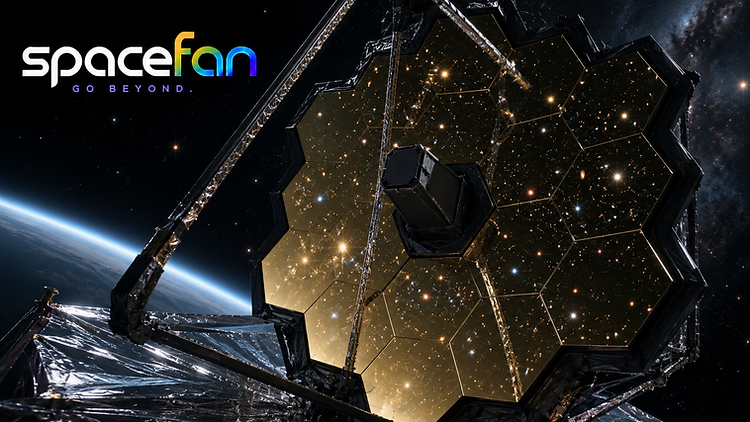
James Webb Space Telescope in space with its gold segmented mirror facing the stars.
Image · Space.Fan

The Drop

For a while, the James Webb Space Telescope has been spotting strange, tiny, and reddish objects in the very distant universe called Little Red Dots. Because these objects are so far away, it is very hard to study what they are actually made of. To solve this, scientists looked for similar objects much closer to Earth using older data from a telescope survey called the Sloan Digital Sky Survey. By searching through this data, they found about 1,300 objects that have the same colors as the distant ones. They are calling these local versions Local Red Dots, or LoRDs. By studying these nearby objects, the team could get a much clearer look at the light and energy coming from them, which helps explain what might be powering the ones far away. They found that these objects likely contain active s, often called quasars, that are hidden behind clouds of dust. This dust makes them appear red and faint, just like the mysterious distant dots.
Advertisement

Why It Matters

This discovery is important because it gives scientists a 'local laboratory' to study these objects in detail. Before this, astronomers could only guess what the far-away dots were because they were too far to see clearly. Now, by comparing the nearby objects to the ones from the early universe, researchers can better understand how supermassive s grow and how they interact with their host galaxies.
Advertisement

The Catch

While these nearby objects share the same color and brightness patterns as the distant ones, they are not exactly the same. The researchers noted that some features, like certain lines in the light spectrum, might only be visible because the local objects are closer to us. This means the researchers have to be careful when assuming that all distant Little Red Dots are identical to the local ones they found.

Put That in Perspective

In the past, astronomers struggled to classify these objects because their light looked strange and did not fit the usual templates for stars or galaxies. This new study helps fill in a gap by using older, well-understood telescope data to shine a light on one of the most confusing discoveries made by modern space telescopes.

Source October 2, 2026
Quinn O. Casey, Ryan C. Hickox, Nikko J. Cleri, Jonathan H. Cohn, David M. Alexander, Emmanuel Durodola, Kelly E. Whalen, Raphael E. Hviding, Tonima Tasnim Ananna
Dartmouth College, The Pennsylvania State University, Durham University, NASA Goddard Space Flight Center, Max-Planck-Institut für Astronomie, Wayne State University·The Astrophysical Journal·10.3847/1538-4357/aea419

Keep Exploring Space