Advertisement
Space.Fan — Go Beyond
ApJ · 15 MIN AGO
UniverseMODEL

Solving the Mystery of Empty Bubbles in Deep Space

By Space.Fan Editorial Desk

Scientists have uncovered how 'ghost bubbles' in giant galaxy groups might be hiding in plain sight by using the Cosmic Microwave Background.
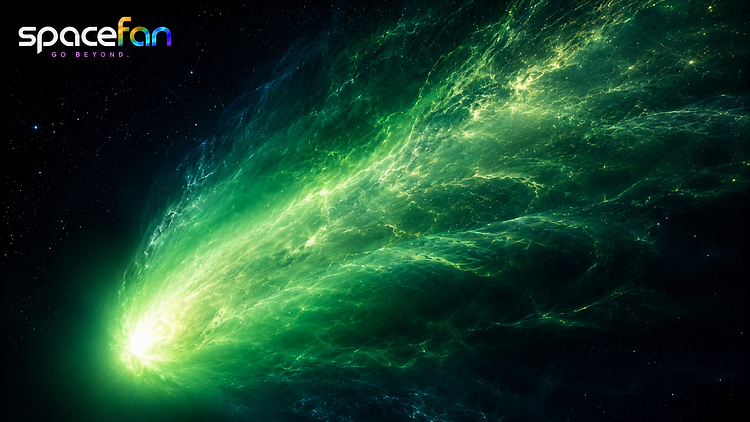
Brilliant green comet with a huge turbulent emerald plasma tail streaming across deep space.
Image · Space.Fan

The Drop

Galaxy clusters are massive groups of galaxies held together by gravity. Inside these clusters, there are often large bubbles, or cavities, filled with invisible energy. For years, scientists have used X-ray telescopes to spot these holes because they appear as dark patches against the hot, glowing gas that fills space. However, seeing these bubbles at great distances is difficult because the light gets distorted. Researchers Ramananda Santra and Samik Mitra have developed a new way to understand what these bubbles are made of. They looked at how the Cosmic Microwave Background—the leftover heat from the birth of the universe—interacts with the particles inside these bubbles. This leftover light hits the particles and cools them down while also creating a faint glow of X-rays. By creating a mathematical model, the team found that these bubbles act as energy traps. Their research suggests that even if a bubble looks faint or disappears from our X-ray maps, it is likely still there, hiding in the data. They tested their model on a distant cluster called SPT-CL J2215−3537 to see if the math held up against real observations. The findings show that only a small amount of energy in the form of particles is needed to make these bubbles visible as dark spots in X-ray images. This helps astronomers explain why some cavities are easy to spot while others seem to fade away, even when they are physically present in the cluster.
Advertisement

Why It Matters

This research is important because it gives scientists a new rulebook for identifying hidden structures in the distant universe. By understanding the link between particle energy and X-ray light, researchers can better map how energy moves through galaxy clusters over billions of years. It also clarifies that these cavities are not just empty space. They contain complex particle populations that change how the cluster appears to our telescopes. This knowledge helps refine our maps of the early universe, where these clusters act as giant laboratories for physics.
Advertisement

The Catch

The biggest uncertainty in this study involves the low-energy particles inside the bubbles. The math is very sensitive to these particles, and because they are hard to detect directly, scientists have to make educated guesses about their behavior. If these guesses are wrong, the estimated energy required to form the bubbles could change significantly.

Put That in Perspective

Scientists plan to use these new criteria to re-examine existing data from high-redshift galaxy clusters. By applying this model to other far-off targets, researchers can better track the evolution of these energetic bubbles across cosmic time.

Source November 25, 2026
Ramananda Santra and Samik Mitra
International Centre for Theoretical Sciences, Tata Institute of Fundamental Research·The Astrophysical Journal·10.3847/1538-4357/aebc4b

Keep Exploring Space