Advertisement
Space.Fan — Go Beyond
ApJ · 22 MIN AGO
UniversePEER REVIEWED

Solving the Mystery of Where Space Silver Comes From

By Space.Fan Editorial Desk

Scientists have tracked down the cosmic origin of silver, revealing that this precious metal is forged in the universe's most violent explosions.
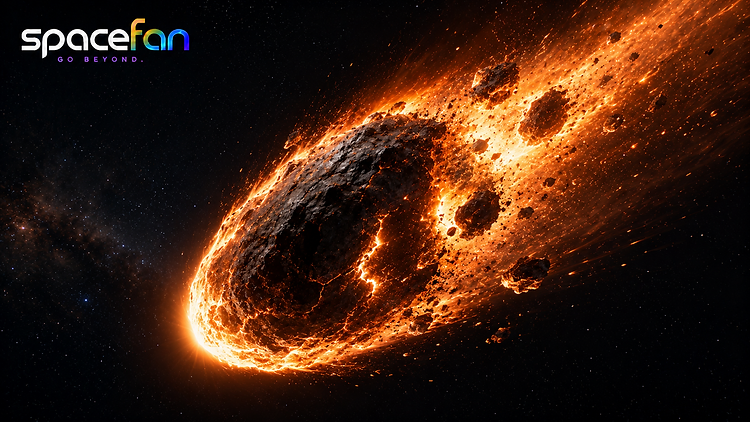
Large fractured asteroid engulfed in flames and glowing debris as it travels through space.
Image · Space.Fan

The Drop

Everything in the universe, including the silver in our jewelry, had to be created somewhere in space. For a long time, it has been hard for astronomers to figure out exactly how silver is made inside s. To solve this, researchers built a complex computer model to simulate how silver atoms act in different types of s. By looking at how light changes when it passes through a 's outer layers, they were able to measure the amount of silver in 41 different s. This new method is much more accurate than older ways of measuring light. The team focused on a process called neutron capture. This is a fancy way of saying that tiny particles called neutrons get smashed into atoms to create heavier elements. By carefully studying the light from these s, they found that silver is mostly made through a specific path called the r-process. This process happens during massive, violent events in space, like when s explode or collide. The team discovered that the amount of silver in these s matches the amount of other rare elements created by these same big explosions. This links silver directly to the most powerful engines in the galaxy, confirming that our precious metals are essentially leftover debris from ancient stellar catastrophes.
Advertisement

Why It Matters

Understanding how silver is made helps scientists build a better map of our galaxy's history. By knowing which s produce certain elements, we can figure out how the chemical makeup of space has changed over billions of years. This study proves that silver is a reliable tracker for the same energetic events that create other heavy elements like europium.
Advertisement

The Catch

While this study is very detailed, it relies on complex models of how atoms behave in space. These models require certain assumptions about how particles crash into each other, which means the final results could shift slightly if our understanding of atomic physics changes in the future. Additionally, the team only looked at 41 s, so there is still much more to learn from other regions of the galaxy.

Put That in Perspective

In the past, measuring silver in stars was very difficult because it is hard to detect. Researchers plan to use these improved methods on even more stars to see if the pattern of silver production holds true across all parts of the Milky Way, helping us connect the dots between atomic physics and the history of our galaxy.

Source November 25, 2026
Lyudmila Mashonkina, Tatyana Sitnova, Svetlana A. Yakovleva, Vera A. Vasil’eva
Institute of Astronomy, Russian Academy of Sciences; Institute of Physics, Herzen University·The Astrophysical Journal·10.3847/1538-4357/aeba82

Keep Exploring Space