
Advertisement
Space.Fan — Go Beyond
ApJ · 7 DAYS AGO
UniverseMODEL

Solving the Mystery of Heavy White Dwarf Stars

By Space.Fan Editorial Desk

Scientists have uncovered a new way to explain how certain massive, long-lived star pairs form in our galaxy.
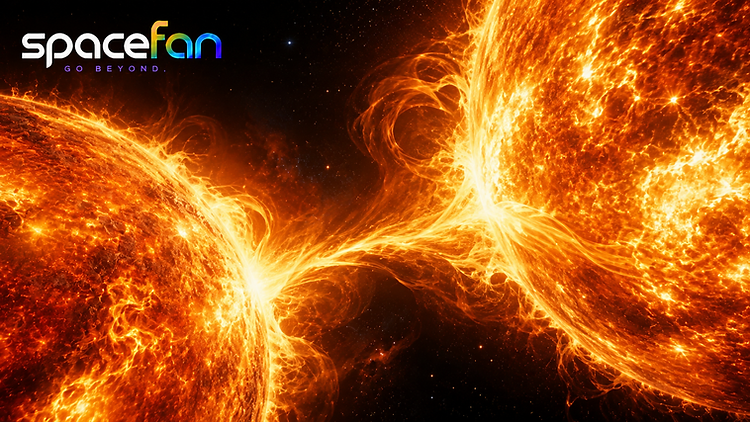
Two fiery stars interacting through huge glowing loops and streams of stellar plasma.

The Drop

A white dwarf is the leftover core of a that has run out of fuel. For a long time, astronomers struggled to explain why some of these heavy white dwarfs are found in pairs that orbit each other for a very long time. Scientists used to think these pairs only formed in one specific, messy way that involves the s crashing together or sharing a shell of gas in a chaotic event. Researchers decided to test a different idea using a powerful computer program called MESA. This tool acts like a digital lab, allowing scientists to simulate how s grow, age, and change over millions of years. By inputting different math models about how s move gas to their partners, the team looked for a smoother process called stable mass transfer. They found that if a middle-sized transfers its gas to a partner in a steady, calm way, it can create these heavy, long-period white dwarf pairs. The models showed that the core of the stays intact throughout this process, which matches what we see in the night sky. This discovery provides a clear explanation for systems that the old theories could not account for.
Advertisement

Why It Matters

This study helps astronomers build a better map of how s live and die. By proving that stable, calm growth is a valid way to create heavy white dwarf pairs, researchers can better track the history of binary systems. It rules out the idea that every massive white dwarf must come from a violent or messy interaction with its partner.
Advertisement

The Catch

This result comes from a computer model, which is a mathematical representation of nature rather than a direct photo or measurement. While the model is highly detailed, it relies on assumptions about how gas moves between s. Future observations of real systems will be needed to confirm that the s actually behave exactly as these computer simulations predict.

Put That in Perspective

Previous research mainly looked at smaller stars, which left a gap in our knowledge about heavier systems. By including intermediate-mass stars in their simulations, the team has expanded the field of study. Scientists will likely use these new findings to check older data and see if they can identify real-world star pairs that match this specific growth pattern.

Source September 17, 2026
Rizhong Zheng, Hongwei Ge, Christopher A. Tout, Hailiang Chen, Zhenwei Li, Dengkai Jiang, Chengyuan Li, Zhijia Tian, Bo Ma, Lifu Zhang
Yunnan Observatories, Chinese Academy of Sciences, University of Cambridge·The Astrophysical Journal·10.3847/1538-4357/ae9d74

Keep Exploring Space