Advertisement
Space.Fan — Go Beyond
ApJ · 3 DAYS AGO
DiscoveriesSIMULATION

Solving the Mystery of How Planets Begin to Form

By Space.Fan Editorial Desk

Scientists compared seven different computer models to see how space dust clumps together to create the seeds of new planets.
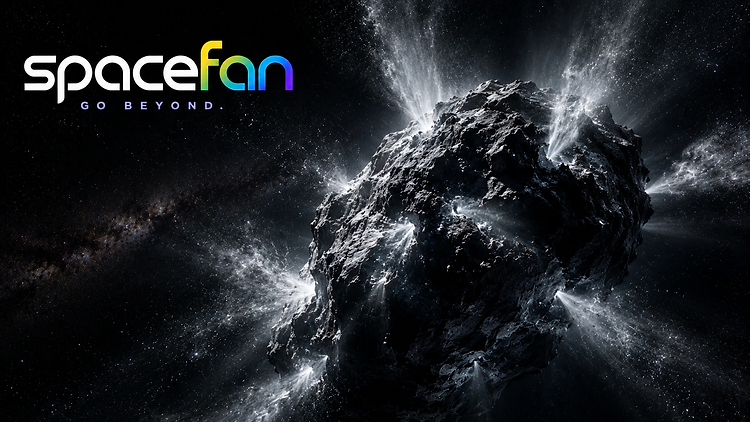
Dark comet nucleus releasing bright jets of gas and dust into surrounding space.
Image · Space.Fan

The Drop

Before a becomes a world, it ts as tiny grains of space dust floating in a spinning disk around a young . A process called the streaming instability helps these tiny grains clump together to form larger rocks, which eventually grow into s. For a long time, scientists have used different computer programs to study this process, but it was hard to know if the different results were true or just quirks of the software. To find the answer, a large team of researchers performed a head-to-head test. They took seven different computer programs used to simulate space and ran the exact same experiment on all of them. They wanted to see if the programs would agree on how the dust piles up and how it moves through space. The researchers found that all seven programs showed the same basic behavior: the dust grew, formed long thin shapes like ribbons, and eventually settled into a steady, turbulent state. This confirms that our current ideas about how -making ts are likely correct and not just mistakes caused by how the computers were programmed. When they looked closer at the details, they did find some small differences. Programs that treated dust like individual particles acted slightly differently than programs that treated dust like a liquid or gas. However, as the researchers increased the resolution of their simulations—making them more detailed—these differences began to disappear, proving that the models are becoming more reliable over time.
Advertisement

Why It Matters

This study is a big deal because it acts like a quality control check for space science. By proving that different computer methods reach the same main conclusions, it gives astronomers more confidence in their theories about how s grow. It helps rule out the fear that our findings were just bugs in the code. Additionally, the study showed that running these giant simulations on a graphics processing unit (GPU), the same type of chip found in gaming computers, is much faster and more energy-efficient than using standard computer processors. This helps scientists learn more about the universe without needing to spend as much energy or time.
Advertisement

The Catch

While the results are very consistent, they only apply to a specific type of dust movement in a simplified environment. The study looked at a specific state where dust grains are not too heavy and not too light. Nature is much more complicated, and real protoary disks contain many different sizes of dust and gas that move in messy, complex ways that these simplified models might not fully capture.

Put That in Perspective

In the past, researchers were often forced to rely on just one type of simulation. This was the first time so many different methods were compared directly. Future studies will likely build on this by adding more realistic conditions, such as the gravity of a nearby star or the complex layering of gases, to see if the streaming instability holds up in more crowded space environments.

Source November 20, 2026
Stanley A. Baronett, Wladimir Lyra, Hossam Aly, Olivia Brouillette, Daniel Carrera, Victoria I. De Cun, Linn E. J. Eriksson, Mario Flock, Pinghui Huang, Leonardo Krapp
University of Virginia, New Mexico State University, Delft University of Technology, American Museum of Natural History, Max-Planck-Institut für Astronomie, Chinese Academy of Sciences, Universidad de Concepción, Université Grenoble Alpes, University of California, Berkeley, Los Alamos National Laboratory, University of Nevada, Las Vegas, Iowa State University·The Astrophysical Journal·10.3847/1538-4357/aeb0a1

Keep Exploring Space